
Why Hybrid And Multi-Cloud Success Depends On Interconnection Strategy In Malaysia

How To Bypass Public Internet Congestion And Bring Cloud Egress Costs Under Control In Malaysia’s Compute Era
Malaysia’s cloud and AI infrastructure race is no longer a future story. MIDA reported that announced investments from Microsoft, Amazon Web Services, Google and Oracle totalled US$23.3 billion. Microsoft made its Malaysia West cloud region generally available in May 2025 with three availability zones, while Google states that it is investing US$2 billion in a Malaysian data centre and Google Cloud region.
The country is rapidly bringing more compute closer to enterprises. Yet proximity on a map does not guarantee proximity on the network.
If traffic between an on-premises system, a private cloud, a public cloud and a second cloud still follow best-effort Internet paths or returns through a distant transit hub, enterprise performance remains exposed to congestion, jitter, variable path length and unpredictable data-transfer charges. The organisation may have modernised its compute estate while leaving its network path in the past.
That is why hybrid cloud interconnection in Malaysia should be treated as a strategic value driver, not a passive telecommunications line item.
Malaysia’s Compute Boom Has Exposed A Network-Path Gap
Malaysia’s national Internet foundation is comparatively strong, but localisation remains an unfinished business. Internet Society Pulse currently gives Malaysia an Internet Resilience Score of 71 out of 100. The July 2026 IXP data also indicates that 89% of active Malaysian networks can exchange traffic through Internet Exchange Points and that 75% of the 1,000 most-visited websites are available through an in-country server or cache.
However, the same resilience dataset assigns Malaysia a traffic localisation score of 44 and a peering efficiency score of 30. These are national indicators rather than enterprise service-level measures, but the contrast is instructive. Interconnection infrastructure is present; the remaining question is whether organisations design their routes, policies and cloud access to use it effectively.
For CIOs and CTOs, the implication is direct: adding local compute capacity does not automatically shorten every workload path. Architecture still decides whether data takes the shortest, sensible route or pays a performance and cost penalty for a detour.
A Local Cloud Can Still Have A Long Route
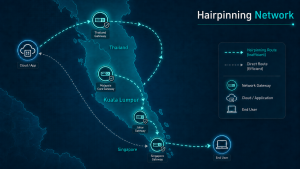
The public Internet is built for reachability. Border Gateway Protocol, or BGP, selects routes according to network policy and commercial relationships, not simply physical distance. A path that looks local to a business user can still traverse multiple networks or a regional transit hub before reaching its destination.
This detour is often called tromboning or hairpin routing. A similar problem appears in multi-cloud environments when traffic must return to an enterprise data centre before being sent to a second cloud. Each avoidable leg adds hops, expands the failure domain and can create another billable transfer event.
The performance concern is not only average latency. Real-time analytics, digital banking, industrial systems, AI inference and customer-facing applications are sensitive to jitter, packet loss and tail latency. A respectable average can hide poor 95th or 99th percentile response times, precisely where users experience stalled transactions, buffering or time-outs.
The Four Business Taxes Of Legacy Interconnection
1. The performance tax
More hops and congested paths increase variability. That makes application behaviour harder to predict and forces engineering teams to compensate with retries, larger time-outs, extra caching or duplicated infrastructure. The business pays twice: once for the network inefficiency and again for the workaround.
2. The egress and cost-governance tax
Cloud egress is rarely a single line item. The true cost can include provider data-transfer-out charges, Internet transit, ports, cross-connects, virtual circuits, last-mile access, managed routing and redundant paths. Moving large data sets among clouds can therefore produce variable operating expenditure that is difficult to forecast.
Private cloud connectivity can improve the equation. It may place traffic on pricing paths with lower egress charges and replace part of a variable transit bill with planned capacity. It does not make data movement free. A credible business case must compare the total cost of each traffic pattern, including connection and resilience costs, rather than advertise a headline saving that may not apply to the enterprise’s cloud agreement.
3. The control and security tax
Public Internet traffic is not automatically unencrypted, and private connectivity is not automatically encrypted. Encryption, identity, routing security and DDoS protection remain separate design decisions. What a direct private path provides is greater control over where traffic travels, fewer uncontrolled
public-network dependencies and a more deterministic foundation for security policy.
4. The complexity and lock-in tax
Building a separate physical circuit for every cloud, site and partner creates operational sprawl. It slows changes and can make an enterprise dependent on a single carrier or topology. A neutral exchange fabric allows multiple logical connections to share a common access platform, giving architecture teams more freedom to add, change or combine services without rebuilding the physical network each time.
What An Interconnection-First Architecture Looks Like
DE-CIX Malaysia provides distinct services for distinct traffic paths. DirectCLOUD offers private access through VLANs to more than 50 cloud service providers, including AWS, Google Cloud, IBM Cloud, Microsoft Azure and Oracle. Cloud ROUTER supports direct, private data exchange between public and private cloud environments, reducing the need to backhaul cloud-to-cloud traffic through a separate data centre.
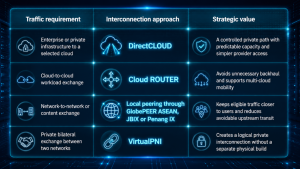
Architecture note: Service and cloud-provider availability should be confirmed for the chosen DE-CIX access location, cloud region and redundancy design.
Why DE-CIX Malaysia And Open DC Matter Together
Interconnection needs both a logical exchange fabric and the right physical locations. DE-CIX Malaysia supplies the exchange, cloud and private-interconnection layer. Open DC provides carrier-neutral data centre access across Malaysia’s central, southern and northern economic corridors.
- JB1 and JB2 in Johor Bahru host DE-CIX JB nodes and support connections towards Singapore, giving enterprises a southern interconnection option close to the Causeway.
- PE2 in Penang includes a DE-CIX node and the Penang Internet Exchange (PIX), supporting the northern manufacturing and digital ecosystem.
- D8-1 in Kedah includes a DE-CIX node near the Malaysia-Thailand border, adding a northern route option for regional architectures.
- CJ1 in Cyberjaya provides a central Malaysian access point with a DE-CIX node and data centre interconnection links.
Choosing a carrier-neutral data centre in Malaysia matters because the facility does not force the enterprise into one telecommunications provider. Network, cloud and route choices can be made according to workload need, resilience, commercial terms and geographic strategy.
Future-readiness must also be described accurately. Nokia announced a 2025 agreement with Extreme Broadband and Open DC to upgrade network capabilities across six Open DC facilities, alongside a memorandum of understanding to collaborate on quantum-safe networking, multi-cloud connectivity and DDoS security. This is a strategic development roadmap, not a reason to assume that every enterprise connection is already quantum-safe or encrypted. Those controls must be specified and validated in the final architecture.
A CIO Decision Framework For Hybrid Cloud Interconnection
A productive interconnection review starts with business-critical flows, not a shopping list of circuits. Ask seven questions:
- Map the workload.Which applications exchange data among branches, data centres, partners and clouds, and which flows are revenue-critical or regulated?
- Measure the actual path. What are the route, hop count, packet loss, jitter and 50th-, 95th- and 99th-percentile latency during normal and peak periods?
- Classify the route. Which flows belong on local peering, private cloud access, cloud-to-cloud routing, data centre interconnection or a protected Internet fallback?
- Cost the full journey.What is the total monthly and per-terabyte cost after provider egress, access ports, cross-connects, transport, managed service and resilience are included?
- Design for failure.Are there diverse physical paths, redundant ports, independent failure domains and tested BGP failover policies?
- Separate privacy from path control.Where are encryption, key management, DDoS mitigation, route filtering and monitoring required, regardless of whether the path is public or private?
- Govern continuously. Who owns route performance, egress variance and service-level reporting, and how often is the design re-tested as cloud usage changes?
The Network Path Is A Strategic Value Driver
The most important multi-cloud question is no longer simply, ‘Which cloud should we use?’ It is, ‘What path should each workload take, with what performance, security, resilience and cost model?’
Without an interconnection strategy, a hybrid or multi-cloud estate can become a collection of isolated services joined by expensive and unpredictable routes. With local peering, private cloud access,
cloud-to-cloud routing and carrier-neutral facilities, it becomes an operating model for workload mobility, cost governance and consistent digital experience.
Malaysia has already made the compute investment. The next competitive advantage will come from engineering the paths between enterprises, clouds, partners and users.
Interconnect in Malaysia. Scale Across ASEAN. Connect Globally.
Working Hours: Monday – Friday, 9am – 6pm
Call Us: +603 9212 5961
Email Us: enquiry@de-cix.my