
From PUE to Peering: The Network Path as a Strategic ESG Imperative

A data centre can operate at a market-leading Power Usage Effectiveness (PUE) of 1.2 and draw 100% of its electricity from solar arrays, yet still sit within an inherently inefficient digital supply chain. If the data traffic leaving that facility travels thousands of unnecessary kilometres across subsea cables and regional clearing points just to reach a user down the road, the facility’s sustainability advantage is largely an illusion.
For telecommunications executives, wholesale leaders, and infrastructure planners across Southeast Asia, digital sustainability has reached a pivotal juncture. Facility-level efficiency is now the baseline table stakes; the next strategic frontier for network efficiency and ESG progress lies in the physical routing of the network path.
The Facility Fallacy: Why Green Data Centres Aren’t Enough
Malaysia’s accelerated digital expansion — anchored by massive capacity deployments across Johor Bahru and Cyberjaya — has drawn intense scrutiny from enterprise clients, global investors, and regulatory bodies. Data infrastructure is no longer evaluated solely on uptime and cost-per-megawatt; it is measured on carbon intensity and resource stewardship.
However, many telecommunications operators suffer from a critical strategic blind spot: evaluating sustainability in silos.
When a network architecture relies heavily on foreign IP transit to exchange domestic traffic, it introduces a structural flaw:
- The Energy Penalty: Every inline optical amplifier, core router, and transoceanic switch processing that packet consumes continuous power.
- The Scope 3 Liability: Unnecessary international hops generate avoidable carbon emissions across third-party infrastructure —undermining corporate Scope 3 decarbonisation targets.
- Operational Margin Compression: Paying international transit rates for traffic that originates and terminates domestically is a direct tax on telco profitability.
Network “Tromboning”: An Unpriced Environmental and Financial Overhead
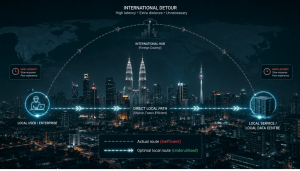
Consider a standard digital interaction originating in Johor Bahru that requests content or cloud resources hosted locally. Without a direct domestic exchange point, that packet undergoes “tromboning” — travelling across regional borders to a hub in Singapore or further afield, before being routed back to its point of origin.
This path adds single-to-double-digit latency milliseconds and multiplies physical energy consumption
per gigabyte.
For network directors and CFOs, hairpinned traffic represents an unsustainable operational cost structure during a period of exponential bandwidth growth. For Sustainability Officers, it represents an unmeasured leakage of carbon efficiency.
The Strategic Lever: Local Peering as a High-ROI ESG Asset
Direct local peering shifts the operational paradigm from passive transit consumption to active ecosystem interconnection. By exchanging traffic locally through a carrier-neutral exchange platform, telcos unlock three strategic imperatives:
1. Granular Decarbonisation & Auditable Metrics
Truncating the physical route of data packets directly reduces the kilowatt-hour footprint per terabyte transferred. This provides telco leadership with hard, auditable operational metrics required for modern ESG frameworks and sustainability-linked financing.
2. Network Resilience and Latency Optimisation
Bypassing international transit bottlenecks reduces domestic latency to sub-millisecond levels. Offloading local traffic from core backbone infrastructure preserves transit capacity for high-margin, genuinely international traffic flows.
3. Capital Efficiency and Margin Protection
Converting variable, volume-sensitive IP transit expenditure into predictable, fixed-port interconnection costs provides structural protection against surging data usage driven by AI workloads, streaming, and enterprise cloud adoption.
Infrastructure Alignment: DE-CIX JBIX Hosted at Open DC
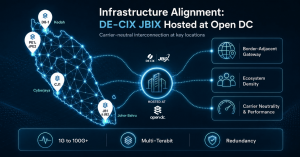
Unlocking the benefits of local peering requires an enterprise-grade, carrier-neutral interconnection ecosystem positioned directly where digital density converges.
This is why DE-CIX Malaysia—incorporating the established ecosystem of JBIX—has deployed its distributed platform within Open DC’s purpose-built facilities, including JB1 and JB2 in Johor Bahru, PE1 in Penang and the upcoming D8-1 DC in Kedah, as well as CJ1 in Cyberjaya.
This strategic deployment offers network decision-makers three distinct structural advantages:
- Border-Adjacent Gateway: The facilities provide an optimal interconnection anchor for regional and cross-border traffic flows—a mere 2 km from the Malaysia–Singapore Causeway for JB1 and JB2 DCs, and 3 km from the Malaysia–Thailand border for D8-1 DC.
- Ecosystem Density: Direct access to a concentrated hub of local service providers, global Content Delivery Networks (CDNs), hyperscale platforms, and enterprise networks.
- Carrier Neutrality & Technical Performance: Built on DE-CIX JBIX’s global interconnection standard, providing multi-terabit capacity, full redundancy, and seamless scalability from 1G to 100G+ ports.
A Challenge for Telecommunications Leadership
Sustainable digital infrastructure cannot end at the facility wall. True operational sustainability requires
an end-to-end view of the data path—from the server rack, across the exchange point, to the end-user device.
If your network is still paying to route domestic Malaysian traffic through international transit hubs,
your architecture contains a structural flaw that compromises both your cost base and your ESG commitments.
Evaluate your current traffic matrix. Identifying which data flows are taking unnecessary international detours—and redirecting them through DE-CIX JBIX at Open DC—delivers an immediate, measurable reduction in transit overhead, latency, and carbon intensity.
Interconnect in Malaysia. Scale Across ASEAN. Connect Globally.
Working Hours: Monday – Friday, 9am – 6pm
Call Us: +603 9212 5961
Email Us: enquiry@de-cix.my