
Beyond PUE: The Architectural Blind Spot Threatening Malaysia’s Digital Growth

Malaysia’s emergence as Southeast Asia’s digital axis is no longer a forward-looking projection—it is an operational reality. Supported by progressive policy frameworks, strategic cloud regions, and a rapid influx of artificial intelligence workloads, cumulative infrastructure commitments have surpassed
RM184 billion. From the Klang Valley to the hyper-density corridors of Johor Bahru, megawatt-scale developments are radically redefining regional data topology.
Yet, as executive teams celebrate gigawatt-scale expansion, an uncomfortable question is beginning to surface in boardrooms: As data throughput scales exponentially, is legacy network architecture silently undermining corporate ESG commitments?
With national data centre power demand projected to exceed 5GW, regulatory bodies such as the Ministry of Investment, Trade and Industry (MITI), alongside institutional investors, are tightening scrutiny around environmental disclosures. Power Usage Effectiveness (PUE) and Scope 3 carbon accounting are no longer treated as passive reporting exercises—they are now decisive variables in enterprise vendor selection and capital allocation.
For telecommunications operators handling terabytes of continuous throughput, achieving meaningful net-zero targets requires looking beyond facility-level power consumption. It demands a fundamental
re-examination of how data travels across physical infrastructure—a strategic pivot toward green interconnection.
The Scope 3 Liability Hiding in Plain Sight
When corporate sustainability teams audit digital supply chains, decarbonisation efforts typically focus on tangible real estate assets: solar installations, liquid cooling deployments, and Green Electricity Tariffs (GET).
While essential, facility-level efficiency measures address only half of the digital value chain. They say very little about the power consumed in moving data across redundant, multi-hop routing pathways.
Traditional IP transit relies on indirect, legacy architecture. When domestic traffic is routed through distant international exchanges—frequently hairpinning from Johor Bahru, Malaysia through Singapore or core gateways in Kuala Lumpur before returning to its local destination—it traverses hundreds of unnecessary physical kilometers.
Every intermediary router, switch, and optical amplifier along that detour consumes electricity continuously. Multiplied across petabytes of monthly traffic, legacy transit pathways represent a massive, frequently unquantified Scope 3 emissions trap.
Redefining Infrastructure for a Sustainable Data Centre Malaysia
To build a genuinely Sustainable Data Centre Malaysia ecosystem, physical facility efficiency must be paired with digital routing optimisation.
A hyper-scale facility can achieve an exemplary PUE metric through advanced cooling engineering and renewable power purchase agreements. However, if the traffic entering and exiting that facility relies on power-hungry, circuitous transport routes across ASEAN, the overall carbon footprint of the digital product remains compromised.
Green interconnection resolves this strategic disconnect by embedding energy efficiency directly into Layer 2 network geometry.
The Architectural Imperative: By exchanging domestic traffic locally and replacing multi-hop transit with direct peering, network operators reduce transport distances, eliminate redundant hardware processing, and lower energy consumption per Terabit delivered by up to 30–40%.
Strategic Breakdown: Legacy IP Transit vs. Green Interconnection
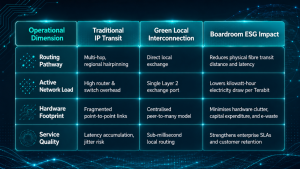
DE-CIX Malaysia: The Infrastructure Platform for Sustainable Growth
To transform ESG compliance from a regulatory tax into a commercial advantage, network operators require neutral, high-density interconnection platforms capable of pairing tier-one performance with measurable carbon reduction.
DE-CIX JBIX operates carrier-neutral Internet Exchanges anchored across the nation’s key digital hubs: Kuala Lumpur, Johor Bahru, Penang and Kedah. By providing a unified local interconnection framework, DE-CIX enables telcos, content delivery networks (CDNs), and cloud providers to re-engineer their routing efficiency.
1. Eradicating Regional Hairpinning
In border hubs like Johor Bahru, substantial volumes of domestic traffic historically crossed international borders simply to be exchanged and routed back. DE-CIX Johor Bahru anchors this traffic locally, eliminating hundreds of kilometres of unnecessary optical transport and drastically cutting associated energy consumption.
2. High-Density, Energy-Optimised Switching
DE-CIX platforms utilise advanced Layer 2 switching technologies engineered for maximum bandwidth density per Watt of power consumed. Connecting to over 140 active Autonomous System Numbers (ASNs) via a single access port enables telcos to consolidate fragmented point-to-point links into one streamlined, energy-efficient interface.
3. Direct Ecosystem Interconnection
Through solutions like GlobePEER ASEAN and dedicated private cloud interconnects
(supporting AWS, Microsoft Azure, and Google Cloud), telcos establish direct routes that bypass public internet congestion. Bypassing unnecessary network hops protects service resilience while directly supporting enterprise decarbonisation targets.
Converting Decarbonisation into Market Leadership
In an increasingly regulated market, ESG strategy can no longer remain divorced from network architecture. As enterprise buyers demand audit-grade sustainability reporting across their entire vendor base, how a network is routed becomes a core commercial differentiator.
Transitioning from energy-intensive IP transit toward direct, local peering with DE-CIX JBIX delivers a clear dual benefit: it lowers network latency and transport costs while visibly shrinking your operational carbon footprint.
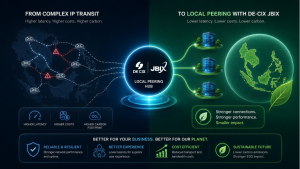
In a hyper-growth environment, green interconnection is more than an operational optimisation—it is the cornerstone of a future-proof, sustainable digital strategy.
Interconnect in Malaysia. Scale Across ASEAN. Connect Globally.
Working Hours: Monday – Friday, 9am – 6pm
Call Us: +603 9212 5961
Email Us: enquiry@de-cix.my