
Re-engineering ASEAN Interconnection: Why Transit Reliance is a Strategic Liability

In the modern enterprise landscape, network performance is no longer an operational detail buried within IT backrooms—it is a core business driver. Yet, as digital economies across Southeast Asia surge, many network architects and infrastructure directors continue to rely on an increasingly outdated model: heavy reliance on global IP transit and centralized transit routes.
As bandwidth demands skyrocket and enterprise workloads shift to latency-sensitive cloud platforms, this traditional approach exposes organisations to margin compression, unpredicted routing paths, and degraded Quality of Experience (QoE).
For digital leaders evaluating their regional footprint, the mandate is clear: Network architecture must evolve from a cost centre into a strategic moat. DE-CIX JBIX provides the enterprise-grade foundation to make that transition seamless.
The Flaw in Legacy Routing Models
The legacy approach to intra-regional traffic distribution suffers from structural inefficiencies. Traffic originating in Southeast Asia (SEA) routinely undergoes unnecessary “hairpinning”—traversing long-haul transit networks or routing through distant regional hubs before reaching an end-user located just across a border.
This architectural legacy introduces three critical business vulnerabilities:
- Eroded Unit Economics: Transit costs scale linearly with volume. As bandwidth consumption accelerates, relying on transit for local traffic unnecessarily inflates operational expenditure (OPEX).
- Unpredictable Latency Budgets: Multiple third-party hops degrade latency control, introducing jitter and packet loss that directly harm real-time cloud, financial, and OTT applications.
- Single-Point Routing Risks: Over-indexing on single regional transit hubs concentrates risk, leaving regional networks vulnerable to localized fiber cuts and congestion bottlenecks.
The Economics of Peering: Direct Control and Cost Predictability
Direct settlement-free peering fundamentally reshapes the economics of digital infrastructure. By exchanging traffic locally at a neutral Internet Exchange (IX), operators bypass intermediaries entirely.
Peering through DE-CIX JBIX allows network service providers, content delivery networks (CDNs), and enterprises to keep local traffic local. The immediate business impact includes:
- Sustained OPEX Optimisation: Shifting high-volume local traffic from paid transit to fixed-port peering significantly reduces average transit bills, unlocking capital for strategic expansion.
- Deterministic Performance: Direct, single-hop interconnectivity delivers ultra-low-latency, providing predictable end-to-end performance for critical cloud workloads.
- Granular Traffic Engineering: Network teams gain precise control over routing paths, improving fault tolerance and simplifying overall traffic management.
A Distributed Platform Engineered for Regional Density
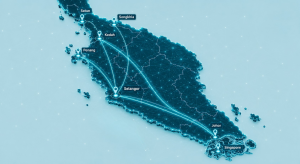
A centralised infrastructure strategy limits geographical agility. DE-CIX JBIX addresses this by operating a carrier-neutral, distributed peering platform across strategic digital gateways in Malaysia—including key nodes in Greater Kuala Lumpur, Johor Bahru, Penang, and Kedah.
This multi-node deployment serves distinct enterprise priorities across the regional connectivity value chain:
- Regional Telcos and ISPs: Exchange traffic locally in regional growth engines like Johor Bahru or Penang without backhauling traffic through national capitals, saving expensive transport backhaul capacity.
- Global Content & Application Providers: Position content caches immediately adjacent to
high-density user bases, guaranteeing optimal Quality of Experience (QoE) during peak demand cycles. - Enterprise & Cloud Networks: Establish private, highly resilient interconnectivity directly into global cloud service providers (CSPs) via integrated solutions such as DirectCLOUD and VirtualPNI, bypassing the public internet altogether.
Single-Port Access, Enterprise-Wide Reach
Scaling network relationships traditionally required navigating dozens of bilateral agreements, physical cross-connects, and varied operational standards. DE-CIX JBIX simplifies this complexity through GlobePEER ASEAN.
With a single physical connection and port at DE-CIX JBIX, your organisation unlocks immediate access to a unified, interconnected ecosystem spanning key markets across Southeast Asia.
Instead of managing complex, fragmented peering arrangements across individual borders, a single port provides instant access to hundreds of active Autonomous System Numbers (ASNs). This drastically reduces administrative overhead, minimises provisioning timelines, and delivers built-in platform redundancy backed by industry-leading Service Level Agreements (SLAs).
Strategic Advantage at the Heart of ASEAN

As Southeast Asia cements its position as a global digital engine, network strategy must keep pace with commercial ambition. Continuing to channel local traffic through transit arrangements is a compromise modern digital enterprises no longer need to accept.
DE-CIX JBIX delivers the technical sophistication, geographical reach, and ecosystem density required to build a resilient, cost-efficient network backbone for the ASEAN region.
Position your network where ASEAN’s digital traffic naturally converges. Reach out to our technical architecture team today to evaluate your routing economics and discover how peering with DE-CIX JBIX elevates your regional performance.
Interconnect in Malaysia. Scale Across ASEAN. Connect Globally.
Working Hours: Monday – Friday, 9am – 6pm
Call Us: +603 9212 5961
Email Us: enquiry@de-cix.my