
The Invisible Detour: Why Your Local Data Leaves Malaysia—and How to Fix Your Network

Local Peering Isn’t Just A Technical Detail. It Is A Vital Test Of Business Continuity, Digital Speed, And Smart Risk Management.
Imagine booking a flight from Kuala Lumpur to Penang. Instead of flying direct across the country, the airline flies you down to Singapore, makes you wait in transit for an hour, and then flies you back up to Penang.
It sounds absurd, yet this is precisely how internet traffic works every single day for thousands of Malaysian businesses.
When a customer in Petaling Jaya accesses an app hosted in Cyberjaya, or a local company exchanges data with a nearby cloud server, business leaders naturally assume the data stays inside Malaysia.
In reality, the internet does not choose routes based on physical maps. It chooses them based on commercial agreements and default computer rules (specifically, a global system called the Border Gateway Protocol, or BGP).
Without direct local connections, two Malaysian networks will routinely send their data across subsea cables to offshore hubs in Singapore or Hong Kong before it returns home.
In tech circles, this is called traffic tromboning or hairpinning. In the boardroom, it should be called what it actually is: an unnecessary delay, an unexpected cost, and a hidden risk to your business operations.
The strategic question facing every enterprise leader is simple: “Do we know which digital roads our company’s data is travelling on, or are we letting default settings make that decision for us?”
The Highway Paradox: Ready Infrastructure vs. Real-World Execution
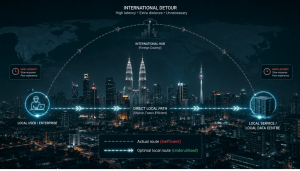
Malaysia’s digital infrastructure is growing rapidly; with its four active Internet Exchange Points (IXPs), connecting over 130 networks. In fact, roughly 89% of active local networks are connected to these exchange platforms directly or indirectly.
This data proves the digital highways exist. However, having national highways ready does not automatically mean your company’s data is driving on them.
A business can invest in modern servers and local data centres, yet its day-to-day traffic can still quietly detour across international waters due to legacy vendor contracts, default network settings, or inherited IT setups. Having world-class local exchanges is useless if your organisation never configures its network to use them.
The Four Business Reasons Every Executive Should Care
Network engineers view traffic as routing tables and technical attributes. For business leaders, unmanaged traffic routes impact four fundamental areas of business performance:
1. Faster, More Predictable Application Speeds
Every extra kilometre data travels causes lag (known as latency). While sending an email can tolerate a brief fraction-of-a-second delay, modern digital tools cannot. Payment systems, mobile apps, video calls, virtual desktops, and cloud databases freeze or slow down when lag increases. Local peering creates a direct shortcut between local networks, removing unnecessary detours and keeping applications fast and responsive.
2. Stronger Protection Against International Outages
Relying on international connections for local data creates dangerous dependencies on underwater sea cables. If an undersea cable gets damaged by ships or weather—a frequent occurrence in Southeast Asia—companies taking offshore detours experience sudden crashes or severe slowdowns. Direct local peering provides a safe, local fallback road. If the international route goes down, your local business data keeps moving inside Malaysia uninterrupted.
3. Lower, More Predictable Operating Costs
Using global internet providers to send data to a business down the street is like paying international long-distance charges for a call to your next-door neighbour. “Public peering” allows local companies to exchange traffic over a shared local platform, reducing the amount of expensive global internet bandwidth they need to buy. This turns growing data usage from an unpredictable expense into a controlled,
cost-effective operation.
4. Full Control and Clear Visibility
When you rely entirely on basic internet connections, third-party service providers decide where your data travels. Local peering puts your IT team back in the driver’s seat. It gives your business clear visibility over where data enters and leaves your network, making it far easier to enforce security policies and protect company information.
Why Regulatory Standards Matter to Every Business
Even if your business is not a commercial bank, strict standards—such as Bank Negara Malaysia’s (BNM) Risk Management in Technology (RMiT) rules—set the baseline for how any modern organisation should handle technology risk.
Rather than giving rigid technical instructions, these regulatory frameworks focus on practical business outcomes.
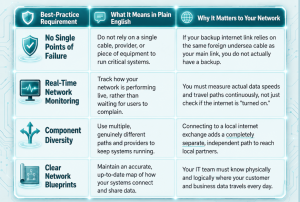
When regulators and auditors review business continuity, they look closely at hidden single points of failure. Demonstrating that your local data stays local is one of the clearest ways to prove your systems are resilient.
Choosing the Right Connection Model for Your Business
A smart enterprise connectivity strategy does not rely on just one type of connection. Different types of work require different digital roads:
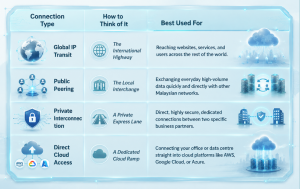
DE-CIX Malaysia operates a distributed exchange platform across major regional economic hubs, including Greater Kuala Lumpur, Cyberjaya, Johor Bahru, Penang, and Kedah. This regional presence allows businesses to connect locally within their home region instead of forcing all network traffic through a single metro gateway.
A Simple 6-Step Audit for Business Leaders
You do not need an engineering degree to bring order to your network architecture. Your technology leadership can follow six practical steps to audit and improve your traffic paths:
1. Identify Essential Apps: List the core applications your customers and staff rely on most (such as payment tools, customer portals, cloud software, and database syncs).
2. Test Actual Travel Paths: Ask your tech team to run simple path-tracing tests (like traceroutes) to see the exact route data takes from offices and user devices to your servers.
3. Expose Hidden Weak Links: Check whether your primary and backup internet lines secretly share the same underlying cables, facilities, or international paths.
4. Compare Practical Options: Evaluate whether switching local traffic to a local internet exchange will lower costs and speed up performance compared to standard internet links.
5. Test Your Backups: Simulate a primary internet failure during planned maintenance to confirm that backup paths kick in smoothly without crashing your apps.
6. Set Up Continuous Tracking: Implement monitoring tools that alert your team immediately if local data suddenly starts taking an unexpected offshore detour.
5 Questions to Ask Your Technology Team Today
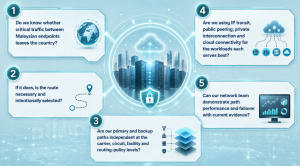
At your next executive or operations review, ask your technology leadership these five straightforward questions:
Data Travel Paths vs. Data Storage
It is helpful to understand the difference between where data is stored and how data travels:
- Data Storage (Data at Rest): Refers to the physical server or data centre where your files, databases, and records are stored.
- Data Travel Paths (Data in Motion): Refers to the physical roads and cables your data travels along when someone accesses or uses it.
Storing your data in a local Malaysian data centre is a great first step, but it only solves half the problem. If your network settings route user traffic through Singapore or Hong Kong to access that local server, your data still takes an offshore trip every single time an application is opened.
Taking Charge of Your Digital Infrastructure
Allowing local business data to take unnecessary offshore detours is an avoidable risk, an unnecessary slowdown, and a waste of operational budget.
For business, IT, and enterprise leaders across Malaysia, network routing is no longer just a technical detail left in the background—it is a core part of business performance, cost control, and risk management.
Take a closer look at your digital roads. Identify your critical business applications, test where your data is travelling, and use local peering to build a faster, more reliable, and cost-effective network foundation.
Interconnect in Malaysia. Scale Across ASEAN. Connect Globally.
Discover how DE-CIX Malaysia can help optimize your enterprise network, improve app speeds, and protect your business operations.
Working Hours: Monday – Friday, 9am – 6pm
Call Us: +603 9212 5961
Email Us: enquiry@de-cix.my