
For ISPs: Keep YouTube And Search Fast Without A Direct Deal With Google

At 9pm, your subscribers are on YouTube. If their video buffers, they do not blame Google. They blame you. For a smaller Malaysian ISP, the path that Google traffic takes into your network decides a large part of how your service feels at peak, and what it costs you to carry.
Until recently, the best path was a direct peering relationship with Google. Most smaller ISPs are never qualified. Now Google recommends something else for them: a Verified Peering Provider. This post explains how ISP Google peering in Malaysia works without a direct deal, and what it changes for your subscribers and your costs.
Why Do Google Services Slow Down At Peak Hours For Smaller ISPs?
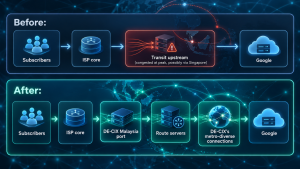
Because of the path, not the content. For most smaller ISPs, Google traffic arrives through one of two routes:
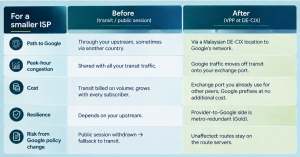
- IP transit. Your upstream carries Google traffic with everything else. At peak, transit links fill up, and you pay for every extra megabit.
- A public peering session at an exchange. Better, but Google is withdrawing from bilateral sessions at internet exchanges worldwide. When the session goes, traffic falls back to transit.
Either way, your Google traffic may cross more networks than it needs to and sometimes leaves Malaysia and comes back. Each 100 km of fibre adds about a millisecond round-trip time, and each extra network adds another place where congestion can build.
Why Can’t Most ISPs Peer Directly With Google?
Google’s direct peering is now built on private network interconnects with physical redundancy: “at least two separate connections to Google in a single metropolitan area.” That means cross-connects, router ports and engineering time to run them, and Google must accept you as a peer. It is designed for large networks with heavy Google traffic. A regional fibre ISP with a few thousand subscribers rarely clears that bar and should not have to.
Google’s own documentation says networks using a Verified Peering Provider “do not need to meet Google’s Direct Peering requirements.”
How Does A Verified Peering Provider Help An ISP?
A VPP holds the redundant private connections to Google, so you do not have to. At DE-CIX, Google’s prefixes are on the route servers. Connect a port, peer with the route servers, and Google’s routes arrive alongside every other network on the exchange. There is no separate product, agreement, or configuration for Google, and no minimum bandwidth.
How Much Transit Can An ISP Save?
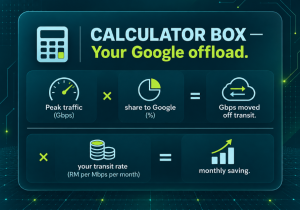
The arithmetic is simple, even though prices are private. Measure what share of your peak traffic goes to Google’s networks. That share can move from transit to your exchange port. Multiply it by your transit rate and you have the saving, before counting the other networks you can peer with on the same port.
For many access networks, Google services such as YouTube are among the largest single sources of traffic at peak. Moving them off transit also gives the rest of your traffic more room on the links you keep.
Can Wholesale Networks Pass VPP On To Their Customers?
Yes. Wholesale carriers and regional networks can use DE-CIX’s VPP status to deliver Google connectivity to the ISPs and enterprises downstream of them. If you sell connectivity to smaller ISPs in East Malaysia, the north or the interior, you can offer them a managed Google path through your DE-CIX connection.
What Will Your Subscribers Notice?
Mostly, they will notice nothing, and that is the point. Fewer stalls when a video starts at peak hour. Video calls that hold their quality throughout the evening. Faster loading for Google services that call back to Google’s network several times per page. And fewer support calls that start with “YouTube is slow tonight”. For a smaller ISP competing with national brands, consistent evening performance is one of the few things subscribers can feel directly.
What Should An ISP Do This Quarter?
1. Measure. Share peak traffic to Google networks, and how it reaches you today.
2. Check your exposure. If you rely on a bilateral session with Google at an exchange, plan it to end.
3. Connect. Take a port at the DE-CIX Malaysia location nearest your core: Kuala Lumpur, Johor Bahru, Penang or Kedah.
4. Peer with the route servers and accept Google’s prefixes. Keep transit as a backup.
5. Make your side redundant with a second port or location if Google traffic is business critical.
The Short Version
Smaller ISPs rarely meet Google’s direct peering requirements, and Google is withdrawing from public peering sessions at exchanges. A Verified Peering Provider gives you a short, redundant path to YouTube, Search and the rest of Google, without a direct deal. At DE-CIX, Google’s routes are on the route servers, at no additional cost and with no minimum bandwidth. Your subscribers notice the difference at 9:00 p.m.
Join DE-CIX Malaysia and bring your Google traffic home. Google VPP is [live at: CONFIRM SITES].
Interconnect in Malaysia. Scale Across ASEAN. Connect Globally.
Working Hours: Monday – Friday, 9am – 6pm
Call Us: +603 9212 5961
Email Us: enquiry@de-cix.my