
Google Workspace Or SASE Feeling Slow? VPP Vs Private Interconnect

When Google Meet stutters or a shared Sheet hang, the problem is rarely Google’s data centre. It is usually the path between your office and Google’s network. Google Workspace performance in Malaysia often comes down to how many networks that traffic crosses, and whether it leaves the country on the way.
There are two ways to shorten that path: a Google Verified Peering Provider (VPP) and a private Google Cloud interconnect. They solve different problems. This post explains which one you need.
Why Does Google Workspace Feel Slow In Some Malaysian Offices?
Workspace is a public internet service. Gmail, Drive, Meet, Docs, and Calendar are reached over public IP addresses. So, the route from your office depends on your internet provider and it’s upstream. If that route goes through transit providers or out to Singapore and back, you add latency and more points where congestion can build at busy times.
Each 100 km of fibre adds roughly one millisecond of round-trip time. A detour from Kuala Lumpur to Singapore and back adds around eight milliseconds of propagation before any queuing. For a video call or a real-time document, those milliseconds, multiplied across every request, are the difference between smooth and sticky.
The same is true of SASE (secure access service edge). If your SASE provider runs on Google Cloud, every user’s traffic goes through it first. A long path to Google slows down everything behind the SASE gateway, not just Google apps.
Can A Private Interconnect Speed Up Google Workspace?
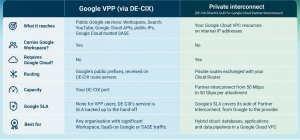
No, and this is the most common misunderstanding. Google states that Cloud Interconnect “does not provide access to Google Workspace.” A private interconnect reaches resources inside your Google Cloud Virtual Private Cloud (VPC) on internal IP addresses. The workspace is not there.
What Does A Verified Peering Provider Cover?
Google says that “any Google service that is reachable over the internet can be used with a Verified Peering Provider.” That includes Google Workspace, Google Cloud APIs, Cloud VPN, public IP addresses on Google Cloud, and SASE services hosted on Google Cloud.
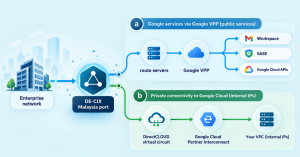
A VPP gives your traffic a short, managed path into Google’s network: from your network to the VPP, then over the VPP’s redundant private connections to Google. DE-CIX is one of the first Internet Exchange operators globally to achieve Google VPP Gold status.
VPP Or Private Interconnect: Which Do You Need?
When Do You Need Both?
When you use Google for productivity and for infrastructure. A bank running Workspace for staff and a core analytics platform in a Google Cloud VPC needs both paths: VPP for Workspace and SASE, private interconnect for the VPC. Both can run over the same DE-CIX connection.
If you only use Workspace and SaaS, VPP is enough. If you only run private workloads in Google Cloud and do not use Workspace, private interconnect may be enough, though Google Cloud APIs are still public services that benefit from VPP.
How Does An Enterprise Connect To Google Via DE-CIX Malaysia?
There are two routes, depending on whether you run your own network.
- If you have your own ASN and routers: take a port at a DE-CIX Malaysia location (Kuala Lumpur, Johor Bahru, Penang or Kedah), peer with the route servers to receive Google’s prefixes, and order DirectCLOUD if you need private Google Cloud access.
- If you rely on an ISP: ask your ISP whether it reaches Google through a Verified Peering Provider. Many Malaysian ISPs and wholesale networks connect at DE-CIX. Choosing one that does gives you the shorter path without running BGP yourself.
How Do You Know Whether The Path Is A Problem?
Before changing anything, measure:
- Trace the route from a user site to a Google Workspace endpoint. Count the networks and look for hops outside Malaysia.
- Measure round-trip time at quiet and busy hours. A big gap suggests congestion on the path.
- Check your SASE provider’s region and how your traffic reaches it.
- Compare sites. If one office is fine and another is slow, the difference is likely the local ISP path.
The Short Version
Google Workspace and Google Cloud-hosted SASE are public services, so a private interconnect will not speed them up. A Verified Peering Provider will, by shortening the path into Google’s network. Use DirectCLOUD for private access to your Google Cloud VPC. Many enterprises need both, over one
DE-CIX connection.
Not sure which you need? Ask which fits your network — a DE-CIX Malaysia engineer will look at your Google traffic with you.

FAQ
Does Google Cloud Interconnect Carry Google Workspace Traffic?
No. Google states that Cloud Interconnect does not provide access to Google Workspace. Workspace is reached over public IP addresses.
Can A Verified Peering Provider Improve Google Workspace Performance?
It can shorten and stabilise the path from your network into Google’s, which reduces latency and congestion. Results depend on your current path.
What Is DirectCLOUD?
DE-CIX’s cloud connectivity service. For Google, it provides Google Cloud Partner Interconnect for private access to your VPC.
Do I Need An ASN?
To peer at DE-CIX, yes. Without one, ask your ISP whether it reaches Google through a Verified Peering Provider.
Interconnect in Malaysia. Scale Across ASEAN. Connect Globally.
Working Hours: Monday – Friday, 9am – 6pm
Call Us: +603 9212 5961
Email Us: enquiry@de-cix.my