Direct Peering, VPP Or Transit: Three Ways To Reach Google, Compared

If you are working out how to connect to Google’s network, there are three practical options: peer directly, connect through a Google Verified Peering Provider (VPP), or buy IP transit and let your upstream carry the traffic. Previously, we explained why the choice matters now: Google recommends VPP over direct peering and is withdrawing from bilateral peering sessions at internet exchanges.
This post puts the three options side by side so you can choose.
What Are The Three Ways To Reach Google?
Direct peering. Your network connects to Google’s network (AS15169) over dedicated private network interconnects (PNIs), usually in a shared colocation facility. You and Google exchange routes directly.
Verified Peering Provider. A provider that Google has verified holds redundant private connections to Google. You connect to the provider, and Google’s routes reach you through it. At DE-CIX, those routes are on the route servers.
IP transit. You pay an upstream carrier for full internet reachability, Google included. Your traffic reaches Google through whatever path that carrier uses.
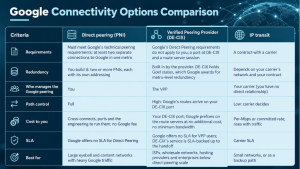
How Do The Options Compare?
When Should You Peer Directly With Google?
When your Google traffic is large enough to justify dedicated infrastructure and you can meet Google’s requirements. Google asks for physical redundancy: “at least two separate connections to Google in a single metropolitan area,” each with its own IP addressing. You also need the engineering capacity to run those connections, monitor them, and respond to incidents.
For the largest Malaysian access networks this can make sense. For most others, the cost of two diverse PNIs, and of the people running them, outweighs the benefit.
When Is A Verified Peering Provider The Right Choice?
When you want a short, managed path to Google without building, and running private interconnects yourself. Google’s documentation describes VPP as “a simple alternative to Direct Peering” in which providers “manage all aspects of the Direct Peering arrangements with Google.”
That is the profile of most Malaysian ISPs, wholesale carriers, data centre and hosting operators, and enterprises with significant Workspace or Google Cloud traffic. At DE-CIX, if you already peer with the route servers, Google’s prefixes arrive there with no new product, agreement or configuration.
When Does Transit Still Make Sense?
Transit is the simplest option and the least controllable. It suits a network whose Google traffic is small, or one that wants a backup path. Its weaknesses show as you grow: cost scales with volume, and you cannot see or influence how your carrier reaches Google. At peak hour, that path may run through congested links or out of the country and back.
What About The Public Internet And Private Cloud Links?
Two edge cases complete the picture.
Public internet. An enterprise with no ASN can simply reach Google over its ISP’s connection. It is cheap and easy but performance is unpredictable. Asking your ISP whether it reaches Google through a VPP is a reasonable question.
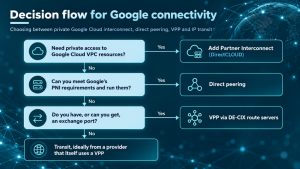
Private Google Cloud connectivity. None of the three options above gives private access to resources inside a Google Cloud VPC that have only internal IP addresses. For that you need Partner Interconnect, which DE-CIX delivers as DirectCLOUD. It is a separate product and complements VPP rather than replacing it. Part five of this series covers when you need both.
How Do You Switch From Transit Or Public Peering To VPP At DE-CIX?
In outline: take a port at a DE-CIX Malaysia location, establish sessions with the route servers, and accept Google’s prefixes. If you already peer at DE-CIX, the last step may be all that is left. Part seven of this series is a step-by-step guide.
The Short Version
Peer directly if you are large enough to build and run redundant private interconnects with Google. Use a Verified Peering Provider if you are not, which is most networks. Keep transit as a backup. Add a private interconnect only if you need internal access to Google Cloud.
Not sure which path fits? Talk to a peering engineer at DE-CIX Malaysia.
FAQ
What are Google’s direct peering requirements? Google asks for private network interconnects with physical redundancy: at least two separate connections in one metro, each with its own IP addressing, plus meeting its technical peering requirements.
Is VPP cheaper than transit? Usually, for Google traffic. At DE-CIX, Google’s prefixes come with your existing port and route server session at no additional cost, while transit is billed on volume.
Does Google give an SLA for peering? Google offers no SLA for Direct Peering or for VPP users. A VPP can offer an SLA on its own network; DE-CIX’s service is SLA-backed.
Can I use VPP and transit together? Yes. Many networks use VPP as the primary Google path and keep transit as a backup.
Interconnect in Malaysia. Scale Across ASEAN. Connect Globally.
Working Hours: Monday – Friday, 9am – 6pm
Call Us: +603 9212 5961
Email Us: enquiry@de-cix.my