
16 Submarine Cables And An Exchange: Kedah’s Delapan Corridor Is A Reach Story

For decades, Northern Malaysia’s economic identity was defined by its agricultural baseline. Kedah served as the nation’s primary food basket—anchored by land, natural resources, and steady domestic supply chains.
Today, that economic identity is undergoing a fundamental strategic shift.
At Bukit Kayu Hitam, on the border connecting Malaysia and Thailand, a new asset class is reshaping the region’s value proposition: the Delapan Special Border Economic Zone (SBEZ).
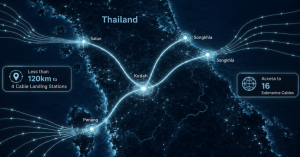
At the center of this development is an unprecedented infrastructure landing: 16 submarine cable systems terminating onshore, anchored by an integrated, high-capacity Internet Exchange (IX).
To view this purely as an IT infrastructure project is to miss the strategic macro-narrative. This is not just a telecom deployment—it is a redefinition of enterprise reach and regional market access.
From Border Outpost To Digital Transit Nexus
Traditionally, border corridors were treated as administrative edge points—chokepoints where physical freight slowed, tariffs were processed, and transport lines terminated.
Modern digital infrastructure inverts this geography.
Subsea fibre-optic routes operate independently of political borders. When 16 international subsea cable systems intersect with overland terrestrial links at a single border corridor, that location ceases to be an edge. It becomes a primary routing hub.
By positioning the Delapan corridor at the crossroad of maritime ocean routes and continental Indochina highways, Kedah is executing a major strategic repositioning:
- Direct Multi-Market Access: Connecting the Indian Ocean trade basin directly to the Greater Mekong Subregion and Indochina.
- Network Redundancy: Establishing a critical bypass route for ASEAN digital traffic, mitigating congestion across traditional maritime chokepoints.
- Latency Optimisation: Intercepting and peering data directly at the border, bypassing legacy off-route routing hubs.
The Infrastructure Case For Direct Peering
In an era driven by cloud computing, automated supply chains, and real-time enterprise architecture, network distance is measured in milliseconds rather than kilometers.
Subsea cables represent the backbone of global commerce. Millions of financial transactions, trade orchestrations, and enterprise data flows rely on the physical continuity of these glass strands.
Integrating an IX directly alongside 16 subsea cable landings provides distinct operational advantages:
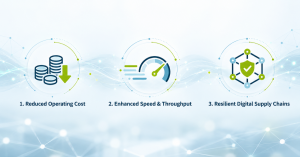
1. Reduced Operating Costs: Direct peering minimises transit fees and third-party route dependencies for regional enterprises and telecom operators.
2. Enhanced Speed & Throughput: Localised data exchange eliminates multi-hop delays to major metropolitan hubs hundreds of miles away.
3. Resilient Digital Supply Chains: High-density connectivity delivers the uptime and low latency required by mission-critical platforms.
What Strategic “Reach” Means For Business Growth
For corporate investors, site selectors, and economic strategists, infrastructure translates directly into competitive advantage. Within the Delapan corridor, reach delivers three distinct value drivers:
- Incentive For Advanced Manufacturing: High-tech manufacturing, automated cold-chain logistics, and AI-driven production facilities prioritise locations offering power stability, high bandwidth, and ultra-low latency.
- Regional Enterprise Scaling: Local businesses and regional enterprises gain direct access to global trade networks without needing to relocate headquarters to tier-one capitals.
- Foreign Direct Investment (FDI) Attraction: The corridor creates an attractive ecosystem for hyperscalers, data center operators, and cross-border logistics firms seeking a secure, strategically positioned ASEAN hub.
Building The Platform For Next-Generation Commerce
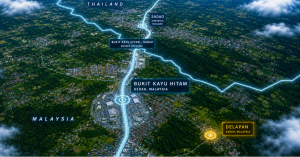
Kedah’s economic evolution demonstrates how strategic infrastructure can redefine a state’s economic role. Just as physical transportation networks enabled the industrial era, digital transit corridors will dictate leadership in the next economy.
By integrating physical border logistics with digital subsea infrastructure, the Delapan corridor shifts Northern Malaysia from a regional pass-through into an international trade orchestrator.
It is a powerful framework for regional development: identifying geography, building foundational infrastructure, and expanding enterprise reach across global markets.
Interconnect in Malaysia. Scale Across ASEAN. Connect Globally.
Working Hours: Monday – Friday, 9am – 6pm
Call Us: +603 9212 5961
Email Us: enquiry@de-cix.my