
How Telcos Can Monetise AI Traffic: Eliminating the Hidden Costs of Hairpin Routing

As Malaysia absorbs massive artificial intelligence (AI) data centre investments, latency remains a critical bottleneck for inference workloads without local traffic exchange. The influx of hyperscale and enterprise AI operations demands infrastructure that can process and transport data with near-instantaneous speed. However, a significant operational risk persists for telecommunications carriers: the reliance on distant international hubs for routing domestic data, a process known as hairpin routing.
The Market Signal: Malaysia’s Surging AI Infrastructure Demand
The digital landscape in Southeast Asia is shifting rapidly. Malaysia is cementing its position as a core digital hub, with over 3GW of new data centre capacity expected by 2030 and a staggering RM90 billion construction opportunity. This boom is driven heavily by generative AI, which requires massive,
capital-intensive infrastructure. Yet, while compute and storage capacities are expanding, the telecommunications network architecture must evolve in tandem to prevent severe bottlenecks.
The Telco Pain: High Transit Costs and Latency Degradation
For network service providers and carriers, hairpin routing presents a significant commercial and operational pain. Routing domestic traffic through Singapore or other distant hubs introduces unnecessary latency degradation, which is detrimental to latency-sensitive AI inference workloads. Furthermore, this inefficient routing incurs high international IP transit costs, severely impacting the overall margin and return on investment for telco infrastructure.
The Solution: Local Peering for Ultra-Low Latency
The solution lies in localising data exchange. By implementing robust local internet peering within Malaysia, carriers can eliminate the need to transit via Singapore for domestic traffic. This strategic network shift drastically reduces latency, improves application performance and optimises transit costs.
It creates a highly resilient and efficient digital ecosystem where telcos can monetise high-capacity data transport.
Unlocking Network Potential with DE-CIX JBIX
To achieve the ultra-low latency required for the AI era, local peering is a strategic necessity.
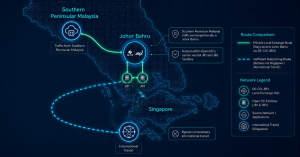
DE-CIX JBIX allows southern Peninsular Malaysia traffic to be exchanged locally in Johor Bahru. Hosted within Open DC’s carrier-neutral JB1 and JB2 facilities, JBIX provides a scalable, membership-free peering platform.
JB1 is situated at Menara MSC Cyberport and supports up to 15MW of IT load capacity. JB2, located at Menara Ansar, offers a dedicated Point of Presence to meet surging peering demands. This empowers telcos to bypass unnecessary international transit, ensuring mission-critical AI workloads perform optimally while preserving margins.
Optimise your AI network architecture and eliminate hairpin routing delays. Talk to our peering experts today to learn more about our local internet peering solutions.
Talk to our peering experts today
Interconnect in Malaysia. Scale Across ASEAN. Connect Globally.
Working Hours: Monday – Friday, 9am – 6pm
Call Us: +603 9212 5961
Email Us: enquiry@de-cix.my