What Does “Gold” Means?: The Redundancy Behind DE-CIX’s Google VPP Status
When you hand your Google traffic to a Verified Peering Provider, you are trusting that provider’s connections to Google more than your own. So, the badge matters. Google VPP Gold is the higher of the two tiers Google awards, and DE-CIX is one of the first Internet Exchange operators globally to achieve Google VPP Gold status.
This post explains what Gold means in engineering terms, what it protects your network against, and what it does not.
How Does Google Rate Verified Peering Providers?
Google enrolls providers that “have demonstrated diverse and reliable connectivity to Google.” To qualify, a provider must have “redundant and physically diverse connectivity to Google’s network” and up-to-date operational contacts. Providers connect to Google exclusively over private network interconnects (PNIs), with dual-stack IPv4 and IPv6. Google “periodically validates enrolled providers against the program requirements.”
Badges come in “one of two tiers, silver or gold, based solely on technical criteria related to their connectivity depth with Google.” In Google’s words:
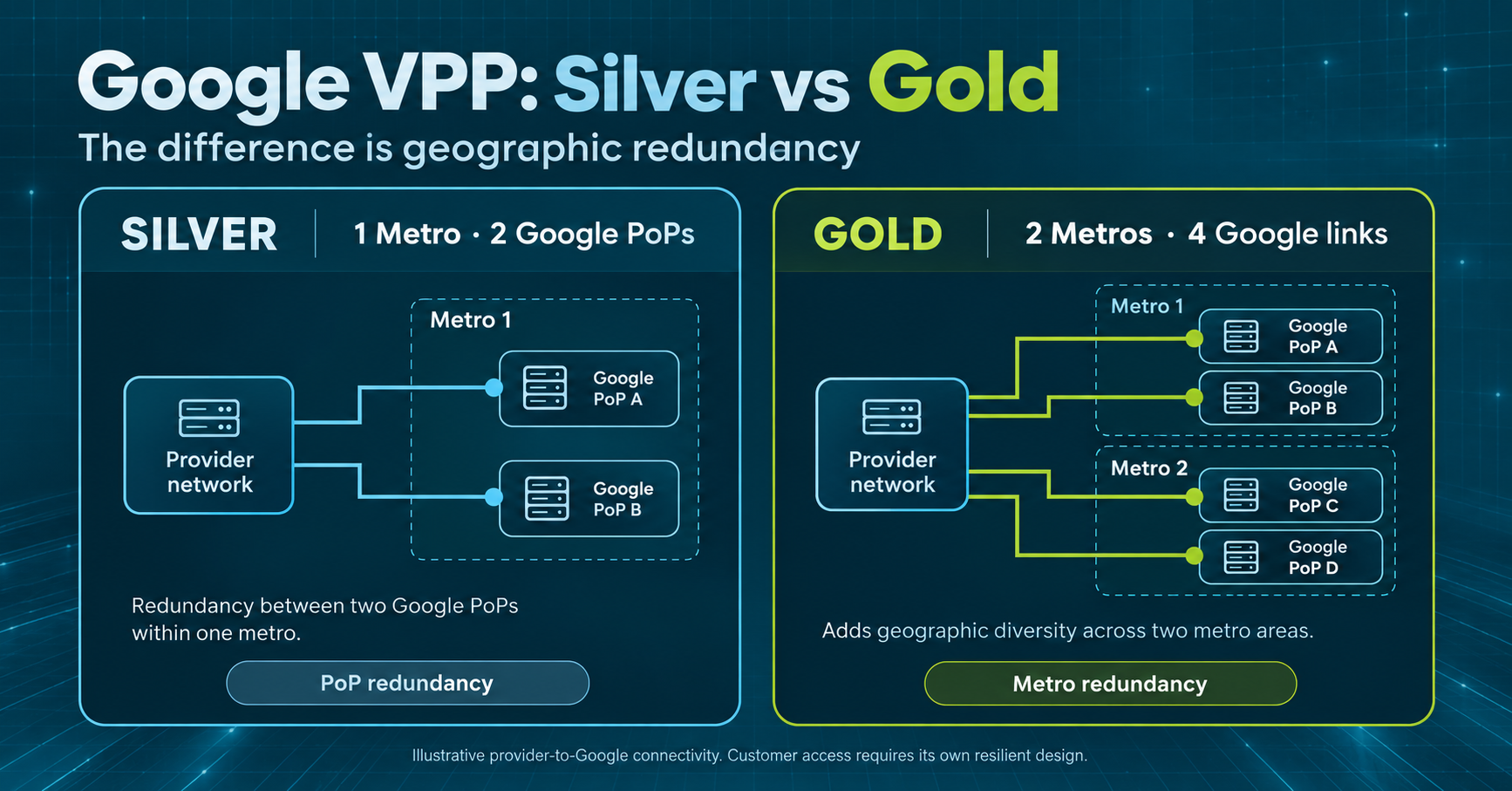
- Silver indicates redundancy across points of presence (PoPs).
- Gold indicates redundancy across metros.
Nothing else goes into the badge: not price, not marketing, not size. It is a statement about how many independent ways the provider can reach Google.
What Is The Difference Between PoP And Metro Redundancy?
A point of presence is a single facility where networks interconnect. A metro is a city or metropolitan area that may contain several of them.
PoP Redundancy (Silver) means the provider reaches Google from more than one facility. If one building loses power or a cross-connect is cut, traffic moves to another.
Metro Redundancy (Gold) means the provider reaches Google from more than one metro. If an entire city’s interconnection is disrupted, by a regional power event, a major fibre cut or a flood, traffic can still reach Google through another city.
The events that cause long outages tend to be regional rather than local. Metro redundancy is designed for exactly those.
What Happens To Your Google Path When Something Fails?
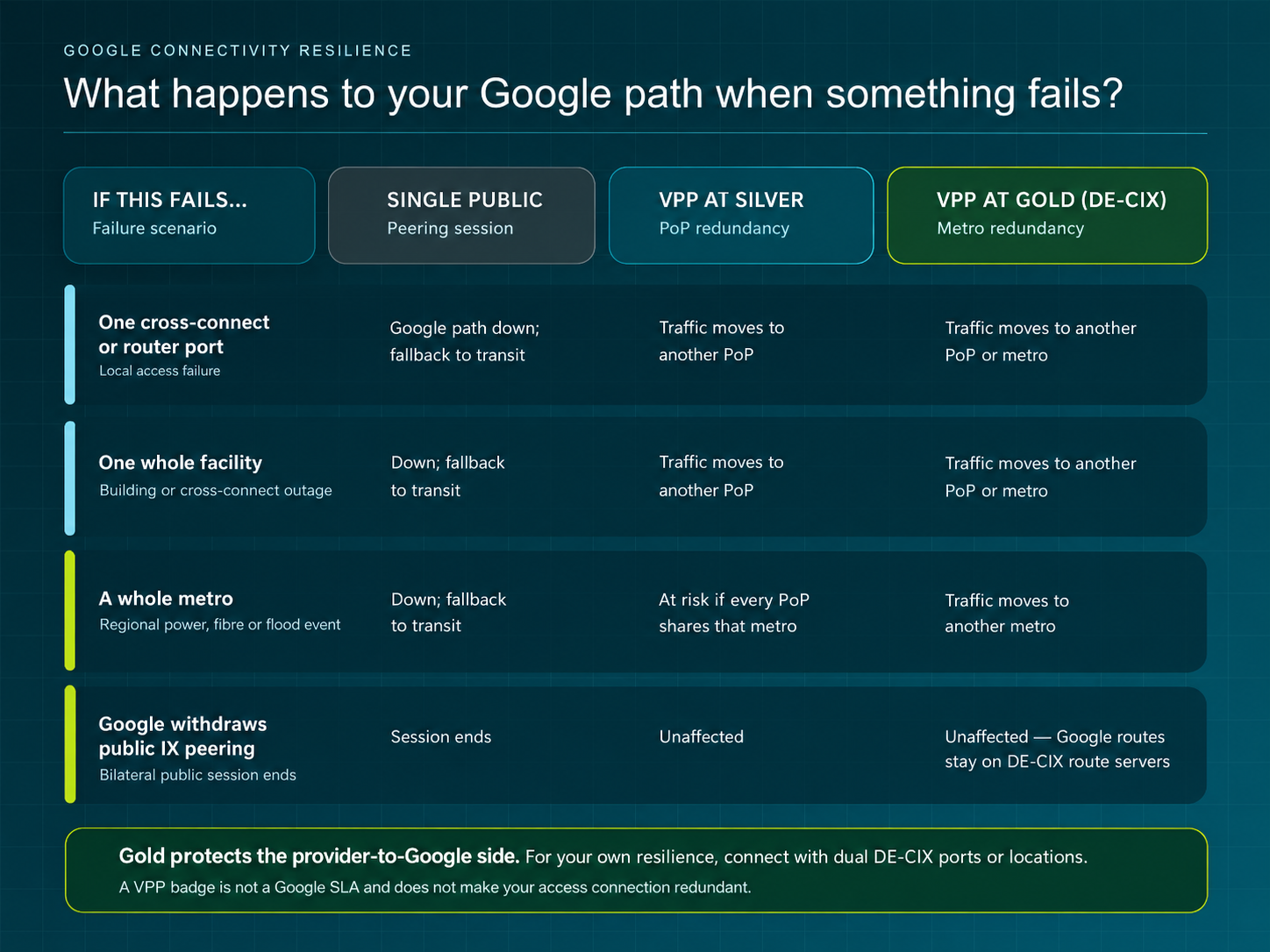
Your own connection to DE-CIX is still yours to make redundant. Gold protects the provider-to-Google side; dual ports or dual locations protect your side.
What Happens If Public Peering With Google Is Withdrawn?
Google is withdrawing from bilateral peering sessions at internet exchanges. A network that relied on that session loses its direct Google path when it ends.
At DE-CIX, Google’s prefixes are on the route servers, carried over DE-CIX’s own redundant, metro-diverse private connections to Google. If you peer with the DE-CIX route servers, your Google connectivity continues regardless of what happens to public peering sessions. You do not need a separate product or agreement.
What Does Gold Not Guarantee?
It is worth being precise, because overselling a badge helps nobody.
- It is not a Google SLA. Google states it “does not offer a service level agreement (SLA) for users of a Verified Peering Provider.” A provider can offer its own SLA up to the hand-off to Google. DE-CIX’s service is SLA-backed.
- It does not make your side redundant. If you have one port in one location, that port is your single point of failure. For critical traffic, connect to DE-CIX at two ports, or two locations.
- It does not mean the provider suits your needs. Google says the VPP label “does not guarantee that the ISP meets your needs.” Location, port speeds, other networks on the platform and support all still matter.
What Should You Ask Any Verified Peering Provider?
1. Which badge, and since when? Gold or Silver, as listed by Google.
2. Where are your PNIs with Google? Which metros and facilities, not just a count.
3. Where can I connect to you in Malaysia? And is Google VPP live at that location today?
4. What is your SLA, and where does it end? Usually at the hand-off to Google.
5. What else is on the platform? A VPP that is also a large exchange gives you Google plus every other network you peer with on one port.
Why Does This Matter More In Malaysia?
Malaysian networks rely on a small number of physical routes out of the country, and a meaningful share of domestic traffic still reaches other Malaysian networks by way of Singapore. Concentration like that is exactly where metro redundancy earns its keep. A Google path that can survive the loss of one metro is worth more in a market where many paths share the same few corridors.
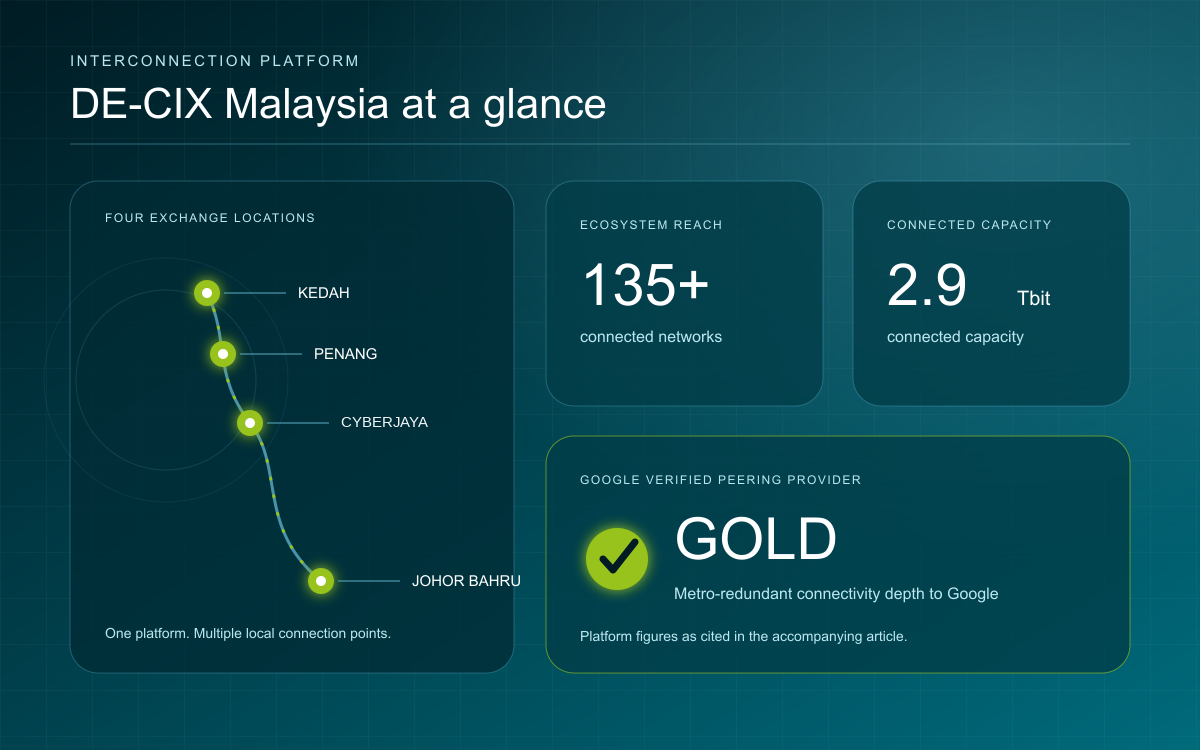
DE-CIX Malaysia connects 135+ networks across Kuala Lumpur, Johor Bahru, Penang and Kedah, with 2.9 Tbit of connected capacity. Google VPP is *[live at: CONFIRM]. On one port, you reach Google through a Gold-rated provider and every other network on the platform.
The Short Version
Google rates Verified Peering Providers on connectivity depth alone. Silver means redundancy across facilities. Gold means redundancy across metros, which protects your Google traffic from regional failures. DE-CIX is one of the first Internet Exchange operators globally with Gold status, and Google’s routes stay on its route servers even if public peering is withdrawn. Make your own side redundant too.
See connected networks on DE-CIX Malaysia, or talk to a peering engineer about your Google path.
FAQ
What does Google VPP Gold mean? It is the higher of two badges Google awards Verified Peering Providers. Gold indicates redundancy across metros; Silver indicates redundancy across points of presence.
Is DE-CIX a Gold VPP? Yes. DE-CIX is one of the first Internet Exchange operators globally to achieve Google VPP Gold status.
Does Gold come with a Google SLA? No. Google does not offer an SLA to VPP users. DE-CIX’s own service is SLA-backed up to the hand-off to Google.
Will I lose Google connectivity if public peering is withdrawn? Not if you peer with the DE-CIX route servers. Google’s prefixes stay there.
Interconnect in Malaysia. Scale Across ASEAN. Connect Globally.
Working Hours: Monday – Friday, 9am – 6pm
Call Us: +603 9212 5961
Email Us: enquiry@de-cix.my