
Gateway to ASEAN: Unifying the Digital Market Through the Northern Interconnection Corridor

The ASEAN digital economy is accelerating toward a $2 trillion valuation by 2030. Yet, for regional telecom providers, OTT platforms, and enterprise CIOs conducting competitive audits of their infrastructure, a critical vulnerability remains. Is your network architecture truly agile enough to cross borders without the burden of latency and transit bottlenecks?
As digital demand scales, seamless data exchange between Thailand, Malaysia, Singapore, and wider Indochina has transitioned from a strategic luxury to an operational necessity.
The Strategic Buyer Pain: Fragmented Cross-Border Routing
Historically, scaling connectivity across Southeast Asia has involved a complex web of bilateral agreements and long-haul public transit routes. This traditional framework introduces severe operational pain points:
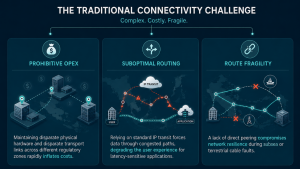
To capture the ASEAN market, forward-thinking operators require a unified regional strategy. The solution lies in leveraging Malaysia’s rapidly evolving data centre ecosystem paired with a distributed Internet Exchange (IX) model.
Malaysia’s Northern Corridor: The New Digital Bridge
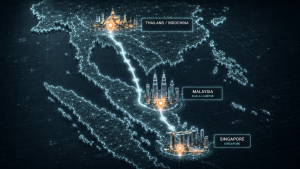
Malaysia is aggressively cementing its position as the ultimate interconnectivity hub, extending well beyond the traditional Greater Kuala Lumpur and Johor borders.
The rapid development of the Thailand/Indochina-Malaysia-Singapore corridor is reshaping regional traffic flows, creating a highly resilient digital bridge. This transformation is anchored by newly completed, AI-ready infrastructure, such as the D8-1 data centre in Kedah’s Delapan Special Border Economic Zone (SBEZ) and the PE2 facility in Penang.
By deploying over 80 MW of combined power capacity across these critical northern edge facilities, infrastructure operators are enabling unprecedented direct paths and peering opportunities for regional traffic flows.
DE-CIX Malaysia: One Port, Limitless Regional Reach
For networks, the expansion of these carrier-neutral facilities creates the perfect environment for intelligent routing. DE-CIX Malaysia operates a highly resilient, distributed IX model designed to sit at the heart of this infrastructure boom.
Through our flagship GlobePEER ASEAN service, we empower networks to simplify their architecture using a ‘one port, many services’ model. Instead of negotiating connections in every target country, networks can plug into DE-CIX in Malaysia and instantly bridge the gap to neighbouring digital economies.
The Strategic Advantages of GlobePEER ASEAN
- Optimised Traffic Flows: By localising traffic along the new cross-border corridors, networks drastically improve route resilience and reduce transit costs.
- Latency Eradication: Direct cross-border peering bypasses the public internet, ensuring flawless, low-latency delivery of high-bandwidth content across Indochina and Singapore.
- Instant Ecosystem Access: Connect once and gain immediate peering access to 50+ networks across the ASEAN region.
- Future-Proof Scalability: Seamlessly upgrade your capacity as regional AI and cloud workloads grow, without deploying new hardware in foreign data centres.
Unify Your ASEAN Strategy Today
The digital borders of Southeast Asia are dissolving. To thrive in this high-growth market, multinational enterprises and telecom providers must pivot toward agile, low-latency, and cost-effective routing architectures.
Stop managing fragmented, long-haul transport links. Expand your network reach across ASEAN with a single connection and start peering intelligently today.
Discover GlobePEER ASEAN and transform your network architecture.
Interconnect in Malaysia. Scale Across ASEAN. Connect Globally.
Working Hours: Monday – Friday, 9am – 6pm
Call Us: +603 9212 5961
Email Us: enquiry@de-cix.my