
Strategic Expansion: What The Launch Of DE-CIX Bangkok Means For Malaysia’s Enterprise And Telecom Ecosystem

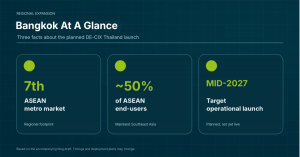
The recent joint venture between DECIX and International Gateway Co. Ltd. (IGC) to establish DE-CIX Thailand in Bangkok. Scheduled to be operational in mid-2027, this deployment marks the seventh metropolitan market integrated into the DE-CIX ASEAN distributed platform.
While DE-CIX Bangkok serves as a critical entry point to Mainland Southeast Asia—a market representing roughly 50% of total ASEAN end-users—it also delivers substantial operational and strategic advantages for telecom operators, ISPs, cloud providers, and enterprises operating in Malaysia.
Regional Integration: The Single-Platform Model
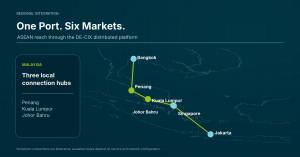
Rather than operating as a isolated regional exchange, DE-CIX Bangkok will be natively integrated into DE-CIX’s broader Southeast Asian interconnection fabric and global backbone.
Through a single port connection, participants across the region gain direct peering access to major ASEAN markets:
This architecture enables seamless, high-performance interconnection across Mainland and Maritime Southeast Asia without requiring multi-vendor infrastructure overhead.
Strategic Implications For The Malaysian Market
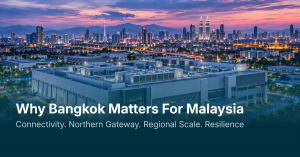
As Malaysia continues to scale its data center infrastructure and digital economy—driven by investment across the Kuala Lumpur–Penang corridor and the Johor–Singapore digital bridge—the addition of Bangkok provides key structural benefits:
1. Enhanced Cross-Border Performance & Latency Reduction
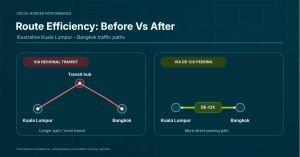
Malaysian service providers and enterprises gain direct, low-latency routing into Mainland Southeast Asia (Thailand, Vietnam, Cambodia, Laos, and Myanmar). Direct peering mitigates unnecessary transit hairpins, significantly improving user experience for real-time applications, content delivery, and enterprise cloud services.
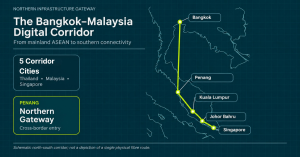
2. Reinforcement Of Malaysia’s Northern Infrastructure Gateway
The Bangkok deployment solidifies the digital highway connecting Mainland Southeast Asia to Peninsular Malaysia.
- Penang acts as the primary physical bridge for cross-border terrestrial traffic into Thailand.
- Kuala Lumpur and Johor Bahru benefit from expanded regional routes, aggregating higher-density traffic flows across the peninsula.
3. Efficient Network Scaling Via GlobePeer Asia
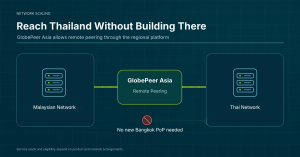
Through DE-CIX’s GlobePeer Asia service, Malaysian entities connected in KL, Penang, or Johor Bahru can peer directly with Thai networks without establishing a physical Point of Presence (PoP) in Bangkok. This remote peering capability lowers capital expenditure (CapEx) while accelerating regional market expansion.
4. Enterprise-Grade Resilience For Mission-Critical Workloads
As demand for AI processing, multi-cloud interconnectivity, and enterprise SaaS increases, network reliability is paramount. Integrating Thailand into the regional fabric provides multi-path redundancy, ensuring route optimization and uptime across cross-border enterprise operations.
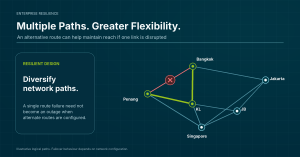
The establishment of DE-CIX Bangkok reinforces Malaysia’s position as a central interconnection hub in Southeast Asia. By bridging Mainland ASEAN into the existing Malaysian digital matrix, DE-CIX provides local networks with enhanced reach, lower operational complexity, and robust regional redundancy.
Contact us today for more deployment and regional peering options across Malaysia and ASEAN
Interconnect in Malaysia. Scale Across ASEAN. Connect Globally.
Working Hours: Monday – Friday, 9am – 6pm
Call Us: +603 9212 5961
Email Us: enquiry@de-cix.my