
Malaysia Is Building 2 GW Of Data Centres. Who’s Building The Fast Lane To Google?

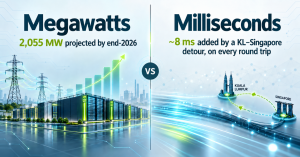
Malaysia’s data centre capacity is projected to reach about 2,055 MW by the end of 2026, up from 522 MW in early 2025. In the first half of 2026 alone, RM95.8 billion of data centre and cloud investment was approved, 44% of everything Malaysia approved. The national conversation is about megawatts, substations, and water.
Interconnection in Malaysia gets a fraction of that attention. Yet every workload in those halls has to reach its users and the services they depend on, and for most of them that includes Google. This post asks who is building that fast lane.
Why Does A Data Centre Need A Fast Path To Google?
Because its tenants do. Think about what runs inside a new Malaysian data hall:
- Cloud and SaaS platforms that call Google Cloud APIs, sign users in with Google accounts, or serve customers who live in Google Workspace.
- AI inference services that answer users in real time, where every round trip adds to response time.
- Enterprises and banks whose staff use Workspace and whose security runs through SASE services; some hosted on Google Cloud.
- Content and media platforms whose traffic mixes with YouTube and Google’s CDN at the same eyeball networks.
If the hall’s path to Google runs through transit, or through Singapore, every one of those workloads pays for it, in latency and in cost.
What Is The Difference Between Megawatts And Milliseconds?
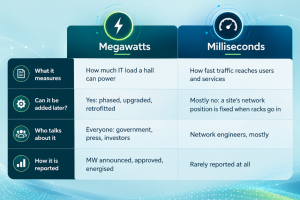
Light in fibre covers about 100 km per millisecond of round-trip time. A Kuala Lumpur workload whose traffic detours to Singapore and back adds around eight milliseconds of propagation before any switching or queuing. For an AI agent making several calls per answer, or a payment passing through several services, that penalty repeats on every hop.
Is Interconnection Keeping Up With Malaysia’s Data Centre Boom?
In parts. Policy has started to notice: the Data Centre Task Force now assesses connectivity alongside energy, water and carbon when it reviews applications, and MIDA has named connectivity infrastructure as an enabler to strengthen. National subsea projects such as SALAM, a planned 3,190 km system linking Johor to Sarawak and Sabah, add physical routes.
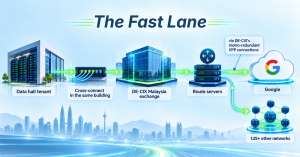
But physical fibre is only half the answer. Traffic also needs somewhere to be exchanged locally, and a short, redundant path into the networks that matter most, Google among them. That is where exchanges and Verified Peering Providers come in.
Who Is Building The Fast Lane To Google?
Google now recommends that networks reach it through a Verified Peering Provider instead of peering directly, and is withdrawing from bilateral peering sessions at internet exchanges. That puts exchanges with VPP status at the centre of the question.
DE-CIX is one of the first Internet Exchange operators globally to achieve Google VPP Gold status. In Malaysia, DE-CIX runs exchanges in Kuala Lumpur, Johor Bahru, Penang and Kedah, with 135+ connected networks. Several sit inside data centres, including Open DC’s JB1 and JB2 in Johor Bahru, CJ1 in Cyberjaya and PE2 in Penang. A tenant in one of those buildings can cross-connect to DE-CIX, peer with the route servers and receive Google’s routes, alongside every other network on the platform. Google VPP is [live at: CONFIRM SITES].
Why Does AI Make Interconnections More Urgent, Not Less?
The megawatt story has adopted AI as its main justification. Training large models is a power problem: it belongs wherever electricity is cheapest and most plentiful, and it is relatively tolerant of distance. Inference is different. Every answer an AI service gives a user involves round trips: a retrieval step, perhaps a call to a search or cloud API, a re-ranking step, then a streamed response. Each of those trips pays for the latency of the path.
Malaysia’s National AI Compute Exchange is due to launch in the first quarter of 2027, with the aim of making compute accessible to local companies. As AI moves from training clusters to services that Malaysian users touch every day, more of the capacity being built will run inference. That capacity will be judged by response time, and response time is decided by where the hall sits on the network.
What Does A Data Hall Without An Exchange Cost Its Tenants?
Three things, usually discovered after go-live.
- Latency. Traffic to Google and other major networks takes the transit path, sometimes out of the country and back.
- Cost. Every megabit to Google that cannot be peered is bought as transit, and that bill grows with the tenant’s business.
- Resilience. One upstream means one failure domain. A tenant with a single transit path has no alternative route when it degrades.
None of these shows up in a megawatt figure, and none can easily be fixed once racks are deployed and contracts signed.
The Short Version
Malaysia is adding megawatts fast. The workloads in those halls will be judged in milliseconds. With Google recommending Verified Peering Providers over direct peering, the fast lane to Google runs through exchanges with VPP status. DE-CIX is one of the first globally at Gold, with exchanges inside data centres across four Malaysian locations.
This is part 6 of our Google VPP series. Read the VPP series from the start, or talk to us about bringing Google VPP into your data centre.
FAQ
How much data centre capacity is Malaysia building?
About 2,055 MW is projected by the end of 2026, up from 522 MW in early 2025.
Why does interconnection matter for data centres?
A hall’s network position decides how fast tenants reach users and services. Unlike power, it is hard to change after racks go in.
Where is DE-CIX in Malaysia?
Kuala Lumpur, Johor Bahru, Penang and Kedah, including inside several data centres.
Interconnect in Malaysia. Scale Across ASEAN. Connect Globally.
Working Hours: Monday – Friday, 9am – 6pm
Call Us: +603 9212 5961
Email Us: enquiry@de-cix.my