
Colocation Is Not Connectivity: Reading Johor’s 0.7% Vacancy Rate Correctly

The Market Moved Faster Than Most Network Plans Did
Johor’s numbers in 2026 describe a different market to Johor in 2023. Contracted capacity went from just under 400MW at the end of 2023 to more than 2.3GW by the end of 2025. Cushman & Wakefield counted 1.11GW operational, 602MW under construction and 2.49 GW in planning during the first half of this year. The colocation vacancy rate is 0.7 percent.
That last figure is the one worth sitting with. It means availability is effectively allocated rather than shopped for, which changes how teams behave. When space is scarce, the negotiation compresses down to power, price and delivery date, and everything else gets deferred to ‘we’ll sort the network out later’.
Later is usually about four months after go-live, when the transit bill arrives and somebody finally looks at a traceroute.
Where The Deployment Checklist Usually Stops
A typical Malaysian colocation evaluation in 2026 is rigorous about the facility. Power density per rack. PUE below 1.25 to satisfy DC-CFA2 criteria. Green Mark certification. Renewable sourcing. Water strategy, which in Johor now genuinely constrains what gets approved. Concurrent maintainability. Delivery schedule against the announced pipeline rather than headline megawatts.
All of that are correct and necessary. And then the network section frequently reads, in full: dual uplinks, two carriers, N+1.
That is a procurement answer to an architecture question.
What The Shortcut Actually Costs
Four failure patterns show up repeatedly in Malaysian deployments:
- Everything rides on IP transit. Transit is billed per megabit and is priced to carry your traffic anywhere on the internet. A large share of a typical Malaysian workload is not going anywhere — it is going to the eyeballs on other Malaysians’ networks. Paying global transit rates to deliver domestic traffic is the most common avoidable line on the bill.
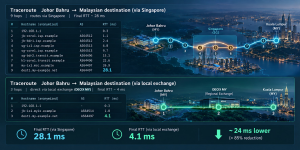
- Domestic traffic leaves the country. Without a local handover point, a packet from your Johor rack to a peer 20km away can still transit in Singapore. You inherit the latency, the cross-border capacity cost, and a dependency on infrastructure outside your jurisdiction.
- Redundancy is nominal, not diverse. Two carriers landing in the same building, on the same duct, reaching the same upstream, is one path wearing two invoices.
- Return paths are unexamined. Teams measure outbound latency and assume symmetry. Asymmetric routing is where the surprising numbers live, particularly for anything interactive.
Peering, Stated Plainly
Peering is the arrangement where two networks exchange traffic are destined for each other’s customers directly, usually without settlement, instead of paying a third party to carry it. Done at an Internet Exchange (IX), it happens over a single physical port into a shared Layer 2 fabric.
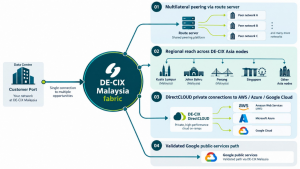
The part that makes it efficient at scale is the route server. Rather than negotiating and configuring a separate BGP session with every network in the building, you establish sessions with the exchange’s route servers and receive the prefixes of every participant that peers multilaterally. One configuration, a large number of destinations, and new participants become reachable as they join rather than as you get around to onboarding them.
DE-CIX Malaysia runs route servers across its Malaysian fabric, so multilateral peering is available from the moment the port is up.
One Access, Several Markets
The structural argument for a distributed exchange is that your port is not confined to the building it sits in.
DE-CIX Malaysia operates across Johor Bahru, Kuala Lumpur, Penang and Kedah, and those exchanges sit inside DE-CIX Asia alongside Singapore, Indonesia, and Brunei. Access in one location gives you reach into networks at the others through the regional peering service. For an OTT or CDN extending out of Singapore toward regional eyeballs, that turns Malaysia into a single interconnection decision rather than four separate ones.
It also matters commercially. Peering in Johor Bahru keeps traffic close to users while avoiding Singapore’s cost base, which is a meaningful part of why the Malaysia-Singapore corridor is now treated as one integrated capacity region rather than a hub and an overflow.
The Cloud On-Ramp Question
Most Malaysian deployments in 2026 are hybrid by default: workloads split across an on-premise or colocation footprint and at least two public clouds. Microsoft’s Malaysia West region went generally available in May 2025 and a Johor Bahru region has been detailed since.
Reaching those clouds over the public internet works, and it also inherits everything the public internet does: variable latency, no performance commitment, and exposure to volumetric attack. A dedicated cloud interconnect service such as DirectCLOUD establishes private virtual connections to providers including AWS, Microsoft Azure, and Google Cloud over the same physical access you already use for peering — SLA-backed and off the public path.
The practical benefit is not only performance. It is that adding a second or third cloud becomes a logical change rather than a new circuit order.
The Google Variable
One change deserves specific attention this year. Google has been winding down settlement-free direct peering arrangements at IX and steering networks toward its Verified Peering Provider (VPP) programme instead. Under it, Google validates providers against its own criteria for connectivity depth, physical diversity and operational responsiveness, then publishes where each one connects.

A Short Evaluation Checklist
Before signing the colocation contract (not after); check the following:
- What proportion of your projected traffic is domestic or regional, and what is it costing you to carry it as transit?
- Which exchanges are present in the facility, and are they distributed across other metros or confined to that site?
- Are route servers available, and how many participant ASNs are reachable multilaterally on day one?
- Are your two upstreams genuinely diverse — different duct, different building entry, different upstream?
- How do you reach each cloud provider today, and what changes when you add the next one?
- Where does your Google traffic currently land, and does that path survive the direct peering wind-down?
The Point
Johor’s scarcity is real and the pipeline is enormous, but pipeline capacity is not deployable capacity. Teams evaluating Malaysia are right to scrutinise delivery schedules and power access. The argument here is simply that interconnection belongs in the same conversation, at the same time, with the same rigour.
The facility determines whether your equipment can run. The interconnection layer determines whether anyone notices.
Interconnect in Malaysia. Scale Across ASEAN. Connect Globally.
Working Hours: Monday – Friday, 9am – 6pm
Call Us: +603 9212 5961
Email Us: enquiry@de-cix.my