
Malaysia Is Building Data Centres At Record Speed. Here’s The Part Most People Never See.

A Very Ordinary Tuesday Morning
It is 8.40am and you are somewhere on the Federal Highway, not moving. You check the traffic app.
You send a voice note to your team. You start a playlist. Three different services, three different companies, and not one of them makes you wait.
That smoothness feels like nothing at all, which is exactly the point. It is also the result of an enormous amount of physical infrastructure, and Malaysia has been building that infrastructure faster than almost anyone in the region.
The Boom You Have Probably Read About
The headline numbers are genuinely remarkable. Knight Frank’s Data Centre Atlas 2026 put Johor’s live IT capacity at 1,110 megawatts, placing it third across Asia-Pacific behind only Tokyo and Singapore.
Its incoming pipeline reached 8,542MW, the largest in the region. Its colocation vacancy rate sat at 0.7 percent, against 4.9 percent in Singapore, 20.5 percent in Jakarta and 23.3 percent in Bangkok.
JLL expects Malaysia’s national capacity to more than double to around 2,055MW by the end of 2026.
In the first quarter of this year alone, the country approved roughly RM34.6 billion in data centre and cloud investment across 33 projects.
Put plainly: Malaysia has gone from being Singapore’s overflow to being the place where
Southeast Asia’s cloud and AI infrastructure actually gets built.

Data Centres Are Warehouses. Something Else Has To Move The Goods.
Here is the part that rarely makes the news. A data centre is, functionally, a very well-guarded warehouse. It has power, cooling, security and space. It holds things: your banking records, the video you are about to stream, the model that answers your chatbot question.
But a warehouse on its own does not deliver anything. It needs roads. More importantly, it needs junctions where delivery trucks from different companies can meet and hand parcels over to each other.
On the internet, that junction has a name. It is called an Internet Exchange, usually shortened to IX. It is a neutral meeting point where separate networks — your mobile operator, your home broadband provider, a streaming platform, a bank, a cloud provider — plug into the same place and pass traffic directly to
one another.
What Happens When The Junction Isn’t There
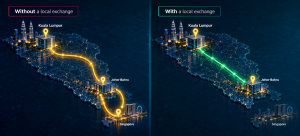
Without a local meeting point, two networks that sit a few kilometres apart may have no direct way to hand traffic between them. So the traffic goes looking for one somewhere else.
For a long time in this part of the world, that somewhere else was Singapore. A message from a user in Johor Bahru to a server in Kuala Lumpur could leave the country, find a handover point across the Causeway, and come straight back. Two Malaysians, two Malaysian networks, one quiet return
trip abroad.
Network engineers have a name for this too. They call it tromboning, because the traffic slides out and back like the instrument. It adds distance, it adds delay, and somebody pays for every kilometre of it.
Milliseconds You Can Actually Feel
A few thousandths of a second sounds like nothing. In practice it is the difference between a conversation and an awkward one.
- On a video call, added delay is what makes two people start a sentence at the same time and then both stop.
- In an online game, it is the gap between reacting and having already lost.
- At a payment terminal, it is the extra beat before the receipt prints while a queue builds behind you.
- On a live match stream, it is hearing your neighbour cheer before you see the goal.
None of these are catastrophes. All of them shape whether people trust a service enough to keep using it.
Why This Matters More Now Than It Did Five Years Ago
Malaysia is no longer just consuming content made elsewhere. It is starting to host the things people connect to. Microsoft’s Malaysia West cloud region in Greater Kuala Lumpur went live in May 2025, with a Johor Bahru region detailed the following November. Budget 2026 put RM2 billion behind a Sovereign AI Cloud under MCMC, so that national data is processed and stored inside the country.
All of that only delivers on its promise if the traffic can reach people efficiently once it is here. A locally hosted service that still routes through a neighbouring country has solved the storage question and left the delivery question open.

Interconnect in Malaysia. Scale Across ASEAN. Connect Globally.
Working Hours: Monday – Friday, 9am – 6pm
Call Us: +603 9212 5961
Email Us: enquiry@de-cix.my