
The Digital Anchor: Why Malaysia’s Internet Remains Resilient Amid Global Uncertainty
In today’s digital economy, the internet is no longer just a convenience. It has become the fourth utility as essential as water, roads, and electricity. From banking and healthcare to education, cloud services, 5G, and data centres, connectivity now underpins how economies operate and how people live.
With ongoing conflict in West Asia and rising geopolitical uncertainty, many Malaysians are asking an important question:
How resilient is Malaysia’s connection to the world?
According to Wong Weng Yew, Board Member of DE-CIX Malaysia, Malaysia is better positioned than many realise.
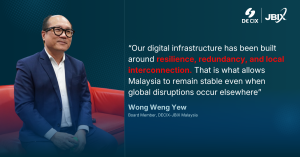
“Our digital infrastructure has been built around resilience, redundancy, and local interconnection. That allows Malaysia to remain stable even when global disruptions occur elsewhere,” he said.
Global Disruption, Local Resilience

Around 97% of international data traffic travels through submarine cables. These cables are the invisible highways of the internet, carrying the world’s financial transactions, cloud services, video calls, enterprise applications, and digital platforms.
When instability affects key maritime corridors, concerns over cable disruption are valid.
However, Malaysia’s digital foundation is not dependent on a single route, single corridor, or single point of failure.
Malaysia currently has 23 operational submarine cables, with six more planned. This provides strategic redundancy, allowing traffic to be rerouted when disruption occurs on any particular path.
The Budget 2026 agenda of RM2 billion commitment to the SALAM project — the MADANI Submarine Cable Connection — further strengthens this resilience. The 3,190km cable will connect Sedili in Johor to Kuching, Sibu, and key areas in Sabah, expanding national capacity while future-proofing Malaysia’s digital infrastructure.
This is especially important as demand for cloud, AI, data centre capacity, and 5G-enabled services continues to grow.
Why Local Peering Matters

Beyond submarine cables, one of the most important pillars of internet resilience is local peering.
DECIX-JBIX plays a critical role here.
As part of DE-CIX’s global internet exchange ecosystem, DE-CIX JBIX enables ISPs, cloud providers, content platforms, enterprises, and digital service providers to exchange traffic locally and efficiently.
Without strong local peering, Malaysian internet traffic may need to travel through international hubs before returning to local users. This increases latency, cost, and dependency on external corridors.
With local peering, traffic stays closer to users.
That means lower latency, improved performance, better cost efficiency, and greater resilience against disruptions happening thousands of kilometres away.
For example, DE-CIX’s exchange enables traffic destined for southern Peninsular Malaysia to be exchanged locally in Johor Bahru, rather than unnecessarily routing through Singapore or other external hubs.
This strengthens Malaysia’s position as a more self-reliant and efficient digital hub.
The DECIX-JBIX Edge in Malaysia
Globally, DE-CIX handled 79 exabytes of internet traffic across its platforms in 2025, representing a 16% increase compared to the previous year and more than double the volume handled in 2020.
In Southeast Asia, DE-CIX’s distributed platform recorded 140% traffic growth in 2025, reaching 1.2 exabytes. Malaysia’s traffic remained steady at 93 petabytes, reflecting a resilient and stable interconnection ecosystem.
For Malaysians, this means the services they rely on — from banking apps and video conferencing to cloud platforms, gaming, enterprise systems, and digital payments — can operate with greater efficiency and reliability.
Local peering is not only a technical advantage.
It is a national resilience strategy.
5G, Data Centres, and Malaysia’s Digital Future

As Malaysia accelerates its 5G rollout and data centre growth, resilient connectivity becomes even more critical.
5G is not just about faster mobile speeds. It supports smart cities, autonomous systems, industrial automation, digital healthcare, connected campuses, and AI-driven applications.
All of these require low-latency, high-availability digital infrastructure.
Data centres, meanwhile, are becoming the backbone of the AI and cloud economy. They must be supported by strong interconnection, diversified routes, secure networks, and resilient exchange ecosystems.
According to Mordor Intelligence, Malaysia’s data centre market is valued at USD 5.48 billion in 2025, with committed hyperscaler investments reaching RM 90.2 billion from major global players including Google, Microsoft, Oracle, and others.
IT load capacity is projected to grow from 1.53GW to 6.43GW by 2031, reflecting Malaysia’s rapid rise as a regional digital infrastructure hub.
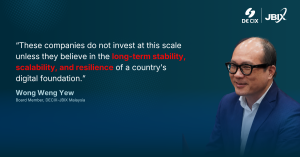
“These companies do not invest at this scale unless they believe in the long-term stability, scalability, and resilience of a country’s digital foundation,” Wong said.
Malaysia as Southeast Asia’s Stable Digital Anchor
The message is clear.
Malaysia is no longer just a participant in the regional digital economy.
It is becoming a stable digital anchor for ASEAN.
Through diversified submarine cable routes, stronger local peering, expanding data centre capacity, and a growing 5G ecosystem, Malaysia is building a foundation designed to withstand disruption and support long-term digital growth.
This matters not only for enterprises and cloud providers, but also for everyday Malaysians.
When people access online banking, stream content, attend virtual meetings, use e-commerce platforms, or rely on digital government services, they are depending on infrastructure that must remain stable regardless of what happens elsewhere in the world.
“Our goal is to ensure that global uncertainty does not dictate Malaysia’s digital experience,” Wong said.
“By strengthening local interconnection, supporting resilient data centre growth, and diversifying our digital infrastructure, Malaysia is positioning itself as a reliable hub for ASEAN’s digital future.”
Built to Stay Connected
The internet is now critical national infrastructure.
As geopolitical risks increase and digital demand continues to rise, resilience can no longer be treated as an afterthought. It must be engineered into the foundation of the network.
Malaysia’s advantage lies in its strategic geography, strong connectivity ecosystem, growing data centre market, and commitment to local interconnection.
While the world may remain unpredictable, Malaysia’s digital infrastructure is being built to endure.
Interconnect in Malaysia. Scale Across ASEAN. Connect Globally.
Working Hours: Monday – Friday (9am – 6pm)
Call Us: +603 9212 5961
Email Us: enquiry@de-cix.my