Cloud Interconnect In Malaysia: Peering, VirtualPNI, DirectCLOUD, Or Google VPP?

The right cloud interconnect in Malaysia depends on the traffic, not the product. Public traffic goes over peering, Google traffic over the Google VPP path, partner traffic over VirtualPNI, and private cloud traffic over DirectCLOUD to AWS and Azure.
AI makes the choice matter more. Inference traffic goes to many users; training data goes to clouds, and model APIs go to partners. Each needs a different path, and most networks need all three.
Which Path Fits Which Traffic?
Start with the traffic type. Then pick the service built for it.
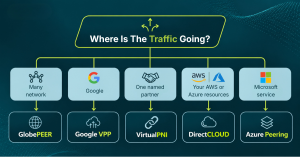
| Traffic Type | Right Path | Why |
|---|---|---|
| To and from ISPs, content, and enterprise networks | GlobePEER public peering, via route servers | One BGP session reaches many networks and avoids paid transit. |
| To Google public services (Search, YouTube, Workspace, internet-facing Google Cloud) | Google VPP path | A verified, redundant path into Google’s network. |
| Between your network and one named partner | VirtualPNI | A private link over your exchange port, with no new fibre. |
| To your private resources in AWS or Azure | DirectCLOUD | A private on-ramp that keeps data off the public internet. |
| To Microsoft services | Microsoft Azure Peering | A direct path to Microsoft’s network. |
When Should You Use Public Peering?
Use public peering for traffic that goes to many networks you do not control. Your router opens sessions with DE-CIX Malaysia’s route servers and learns routes from every network that peers through them.
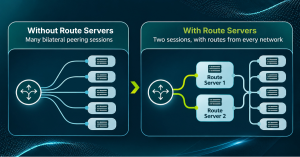
This is the default path for inference serving, content delivery and ISP traffic. It also replaces transit for every destination reachable on the exchange. Our FAQ explains how transit differs from peering.
When Should You Use The Google VPP Path?
Use it for traffic to Google’s public services. Google now reaches many networks through Verified Peering Providers (VPPs), which must meet its redundancy rules.
DE-CIX is “one of the first Internet Exchange operators globally” with Google VPP Gold status. Networks too small to meet Google’s own peering rules can still get a verified path through the exchange.
For setup steps, read Peering with Google in Malaysia and our October post, Google changed how networks reach it.
When Should You Use VirtualPNI?
Use VirtualPNI when two networks want a private link but do not want to lay a cross-connect for it. It runs as a private connection over the exchange port you already have.
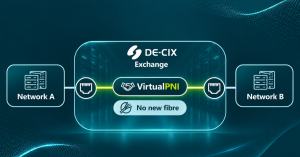
It suits fixed, high-volume relationships. Examples include a GPU cloud and an enterprise that uses its models, or a content network and a large ISP. You can turn one up without a new physical port at either end.
When Should You Use DirectCLOUD?
Use DirectCLOUD for traffic to your own private resources inside AWS or Azure. It gives you a private cloud on-ramp from the exchange, so data, backups, and training sets stay off the public internet.
This is the path behind searches for AWS Direct Connect and Azure ExpressRoute in Malaysia. DirectCLOUD reaches those cloud services from your DE-CIX port, without a separate carrier circuit to each cloud. See the DirectCLOUD page.
Which Path Should A Data Center Tenant Choose For AI Traffic?
AI workloads use several paths at once. Match each flow to its path.
| AI Flow | Path | Reason |
|---|---|---|
| Serving inference to users | GlobePEER, plus the Google VPP path | Short paths to many ISPs and to Google. |
| Moving training data to and from a cloud | DirectCLOUD | Private, high-volume transfers to AWS or Azure. |
| Calling a partner’s model API | VirtualPNI | A private link to one named network. |
| Reaching Microsoft services | Microsoft Azure Peering | A direct path to Microsoft’s network. |
McKinsey expects inference workloads to grow about 35% a year over the next five years. That growth lands mostly on the public peering and Google paths, so size those first.
Can One Exchange Port Carry Every Path?
In most designs, yes. Public peering, the Google VPP path, VirtualPNI, and DirectCLOUD can run as separate services over one physical port. That keeps cross-connects to one per site.
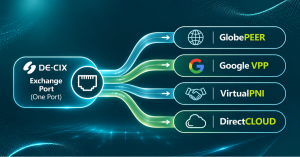
For resilience, take a second port in another region. DE-CIX Malaysia offers access in Johor Bahru, Kuala Lumpur, and Cyberjaya, and Penang, with a Kedah node targeted for end-2026 or January 2027.
What Mistakes Do Networks Make When Choosing A Path?
- Sending private cloud data over public peering, then adding encryption and capacity to compensate.
- Buying a separate carrier circuit for each cloud when one exchange port can reach them.
- Leaving Google traffic on transit after Google’s move to Verified Peering Providers.
- Building a physical private interconnect for a link that a VirtualPNI could carry.
- Running every path through a single port in one region.
Ask which path fits. Send us your traffic mix by destination. A peering engineer will map each flow to a path and tell you what one port can carry. Ask which path fits →
FAQs
What is the difference between peering and DirectCLOUD?
Peering exchanges public internet traffic with many networks through the exchange route servers. DirectCLOUD is a private ramp to your own resources in AWS or Azure, so that traffic does not cross the public internet.
What is a Google Verified Peering Provider?
A Verified Peering Provider (VPP) is a network or internet exchange that Google endorses to give other networks a diverse, highly available path to its services. DE-CIX holds Google VPP Gold status.
What is VirtualPNI?
VirtualPNI is a private link between two networks that run over their existing DE-CIX exchange ports. It gives the privacy of a private network interconnect without laying out a new cross-connect.
Interconnect in Malaysia. Scale Across ASEAN. Connect Globally.
Working Hours: Monday – Friday, 9am – 6pm
Call Us: +603 9212 5961
Email Us: enquiry@de-cix.my