
Redefining The ASEAN Digital Highway: Why The Kedah–Bangkok Border Peering Point Changes Everything

For years, the story of cross-border connectivity in Southeast Asia was bound by a familiar routine: traffic originating in Malaysia or Thailand often had to travel down to centralised hubs in Singapore or route through long-haul backbones to resolve, adding milliseconds, backhaul costs, and systemic complexity.
That paradigm is undergoing a structural shift.
With the deployment of the new DE-CIX node at Open DC’s D8-1 Data Centre in Bukit Kayu Hitam, Kedah, direct cross-border peering point is taking shape right at the Malaysia–Thailand frontier.
It begs an important question for network architects, Internet Service Providers (ISPs), and content delivery networks (CDNs) across the region: Why route around the border when you can peer directly at it?
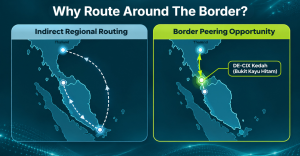
1. Decentralising The ASEAN Digital Spine
Traditional network design heavily relied on distant capital hubs. However, as real-time digital applications – such as cloud services, high-frequency gaming, financial technology, and live video streaming – demand microsecond-level precision, the physical location of interconnection matters more than ever.
Situated within the Delapan Special Border Economic Zone (SBEZ), the D8-1 facility sits less than 6 km from the border, bridging the telecommunications corridor between Malaysia and Thailand. By placing a neutral Internet Exchange right where terrestrial fibres cross, networks no longer need to haul border traffic down to regional capitals just to exchange packets.
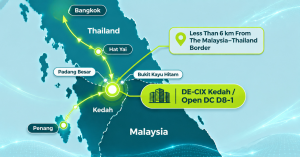
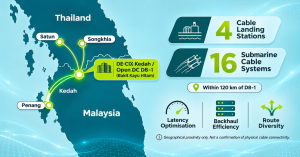
2. Unlocking 16 Submarine Cables & 4 Landing Stations
The geographic advantage extends beyond immediate cross-border land links. The Kedah peering node sits within 120 km of four major subsea cable landing stations – including critical landings in Satun and Songkhla on the Thai side.
This proximity connects terrestrial routes across Indochina directly with 16 submarine cable systems terminating in the region.
- Reduced Latency: Shorter physical paths significantly cut down Round-Trip Time (RTT).
- Lower Backhaul Costs: Eliminate unnecessary transit legs and trombone routing.
- Greater Resilience: Provides redundancy against single-point outages in capital-city infrastructure.
3. A Gateway Into Indochina
This node is designed not merely as a localised access point for northern Malaysia, but as an interconnection engine for broader Indochina.
Networks operating out of Thailand, Laos, Cambodia, and Vietnam gain direct, low-latency access to Malaysian fibre networks and global cloud ecosystems through a single port on the DE-CIX platform.
Be A Part Of The Foundation
Be early adopters to enjoy unique opportunity to shape the traffic dynamics of this key corridor. We invite Thai, Malaysian, and Indochina networks to secure their position in this evolving ecosystem.
Interconnect in Malaysia. Scale Across ASEAN. Connect Globally.
Working Hours: Monday – Friday, 9am – 6pm
Call Us: +603 9212 5961
Email Us: enquiry@de-cix.my