
Local Value, Measured In Packets: Why Malaysian Telcos Must Keep Traffic Domestic

When Members of Parliament recently questioned the tangible returns on Malaysia’s RM385.7 billion digital and data centre investments, the spotlight turned directly to the nation’s digital backbone: our telecommunications infrastructure.
For telecom operators, mobile network operators (MNOs), and Internet Service Providers (ISPs), expanding network coverage and rolling out 5G are only part of the equation. The key to sustainable profitability and superior customer experience lies in routing efficiency: how effectively are we routing domestic data traffic within our own borders?
If your network routes local subscriber and corporate traffic out of the country only for it to return home, your business incurs unnecessary transit expenses while missing strategic opportunities in the enterprise market.
The Hidden Costs Of Data Detours
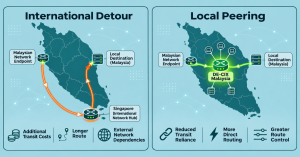
In the telecommunications sector, routing local data across international borders—often referred to as traffic hairpinning—remains a persistent operational challenge.
When a domestic user accesses a local cloud application or digital service, but that connection travels through international hubs in neighbouring countries before returning to Malaysia, it creates three major business bottlenecks:
- Inflated Operational Expenses: Paying international IP transit rates for data that stays within national borders erodes profit margins. Transit budgets should support genuine international traffic, not domestic routing.
- Diminished 5G Performance: Operators have made significant investments in 5G and edge computing to deliver ultra-low latency. Sending data on an international detour introduces lag, neutralising the advantages of next-generation mobile networks.
- Subsea Cable & Port Congestion: Routing local traffic over international subsea infrastructure consumes critical capacity, increasing exposure to cable outages, and external network disruptions.
Unlocking B2B Enterprise Growth
Beyond cost optimisation, local traffic management provides telecommunications sales teams with a strong competitive advantage in the enterprise market.
As the Malaysian government champions sovereign cloud initiatives, digital transformation programs, and strict data protection frameworks, corporate clients—particularly in banking, healthcare, government, and manufacturing—increasingly prioritise data security and localised connectivity.
For telcos looking to grow Average Revenue Per User (ARPU), data sovereignty in Malaysia applies to data in transit just as much as data at rest.
By keeping traffic local, operators can introduce and monitise high-margin enterprise solutions:
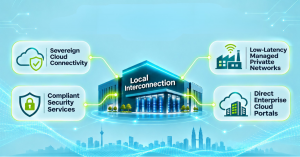
1. Sovereign Cloud Connectivity: Organisations deploying sensitive AI and digital workloads require guarantees that their data will not exit national borders. Local interconnection enables telcos to deliver secure, direct cloud links backed by strict Service Level Agreements (SLAs).
2. Low-Latency Managed Private Networks: High-value enterprise applications—such as smart manufacturing, automated logistics, and real-time financial trading—require guaranteed sub-millisecond response times. Local routing allows operators to position high-performance private connectivity at a premium over standard internet access.
3. Compliant Security Services: Financial institutions and regulated enterprises must comply with stringent national guidelines (such as Bank Negara Malaysia’s Risk Management in Technology standards). Telcos can package verified in-country traffic routing and reduced exposure to external cyber threats into managed security offerings.
4. Direct Enterprise Cloud Portals: Rather than selling basic bandwidth, operators can bundle business connectivity with fast, direct access to major cloud platforms hosted locally, capturing higher margins from digital-first enterprises.
Optimising Network Strategy With Local Peering
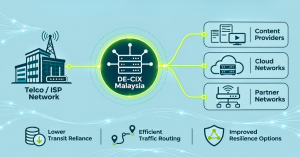
The solution for network executives and wholesale leaders is simple: direct, neutral, local interconnection.
By connecting to a local Internet Exchange point like DE-CIX in Malaysia, telcos, and ISPs establish direct peering relationships with local content providers, cloud networks, and partner operators.
Local peering delivers three primary benefits to your network architecture:
- Reduced Transit Overhead: Offloading domestic traffic from international links significantly lowers transit bills and improves cost per gigabit.
- Consistent Quality Of Experience: Shorter, direct data paths minimise latency, delivering smoother digital experiences for enterprise and retail customers alike.
- Enhanced Network Resilience: Keeping domestic data within the country protects your core network from international subsea cable disruptions, safeguarding business continuity.
Transform Network Architecture Into Commercial Growth
Malaysia’s digital economy is accelerating rapidly. For telecommunications providers, refining traffic architecture is a direct path to lowering costs, fulfilling 5G performance targets, and capturing new revenue in the corporate cloud market.
Is your network paying international transit fees for local data traffic? Eliminate unnecessary detours, lower operational overhead, and launch high-value enterprise connectivity services today.
Interconnect in Malaysia. Scale Across ASEAN. Connect Globally.
Working Hours: Monday – Friday, 9am – 6pm
Call Us: +603 9212 5961
Email Us: enquiry@de-cix.my