
Interconnection: The Next Test for Malaysia’s Data Centres

Malaysia now judges data centres on power, water, efficiency, and local value. Interconnection in Malaysia is the next measure, and the Data Centre Task Force has already started applying it: since September, applications have been assessed on their investment value, their energy and water requirements and their connectivity needs.
An internet exchange draws little power and almost no water, yet it decides how quickly services reach users and whether Malaysian traffic stays in Malaysia. On 19 October, the National Economic Action Council agreed to draft a Digital Infrastructure (Data Centre) Bill for Cabinet in 2027, with domestic economic value as one of its aims. Connectivity belongs in the same conversation.
Four Measures In Place, One Taking Shape
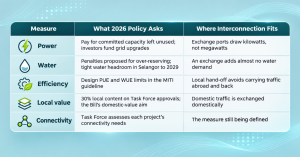
MITI, the Ministry of Investment, Trade and Industry, sets design limits for power usage effectiveness (PUE) and water usage effectiveness (WUE) through its guidelines.
Connectivity Is The Next Measure
As of August 2026, Malaysia’s 45 operating data centres drew about 1.37GW against 6GW of contracted load, and AI tenants are signing before capacity is built. In October, Singapore-founded AI cloud provider Aolani signed letters of intent for 500MW of Tier III capacity across several Malaysian sites from the second half of 2027. Every hall that fills adds traffic that must reach clouds, content networks and users.
Network position is set early. Power can be phased and cooling retrofitted, but a hall’s place on the network is largely fixed once racks go in. A tenant that finds out late that its nearest exchange is in another state, or another country, pays for it in latency and transit for the life of the contract.
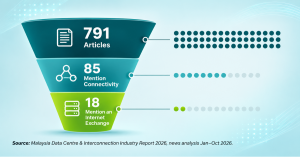
And the topic is rarely discussed. In our review of 791 Malaysian data centre news articles published between January and October 2026, 85 said anything about connectivity and only 18 mentioned an internet exchange. Power and water dominate the debate, which makes the network easy to leave until the end.
An Internet Exchange Strengthens Local Value
An internet exchange is a neutral switching platform where networks hand traffic directly to one another. When two Malaysian networks peer at a Malaysian exchange, the traffic between them does not need to leave the country.
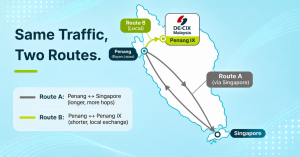
That supports three outcomes policymakers care about. Domestic traffic stays domestic, which fits the local-value aim of the proposed Bill. Paths get shorter, because traffic no longer detours through Singapore; as a rule of thumb, every 100km of fibre adds about one millisecond of round-trip time. And networks buy less long-haul capacity and transit, which lowers the cost of serving Malaysian users.
Peering is not an automatic compliance result. Routing still depends on the policies of the networks involved, and some traffic will always leave the country. What an exchange provides is a local option, so the route becomes a choice rather than an accident. The ecosystem is ready to use it: 89% of Malaysia’s 268 domestic networks can already exchange traffic through an internet exchange point.
DE-CIX Malaysia’s Footprint And Services
DE-CIX Malaysia provides access across three regions: Johor Bahru; Kuala Lumpur and Cyberjaya; and Penang, where Penang IX, powered by DE-CIX, is located at Open DC PE2. A node at Open DC D8-1 in Bukit Kayu Hitam, Kedah, is targeted for the end of 2026 or January 2027, as reported in September 2026. D8-1 is within reach of four cable landing stations, two of them in Thailand.
On each port, networks can use GlobePEER for public peering through the route servers, VirtualPNI for private links to specific networks, and DirectCLOUD for private connections to AWS and Azure. DE-CIX is also one of the first internet exchange operators globally with Google VPP Gold status, giving networks a verified path to Google’s public services. Our page on peering with Google in Malaysia explains how it works.
Our View
Malaysia has asked data centres to show that they use power and water well. We believe connectivity deserves the same attention, because it decides what users actually experience. The Task Force has started that work, and the industry is well placed to help define what good looks like.
See who you can reach. Browse the networks connected to DE-CIX Malaysia and plan your peering before your racks go in.
Interconnect in Malaysia. Scale Across ASEAN. Connect Globally.
Working Hours: Monday – Friday, 9am – 6pm
Call Us: +603 9212 5961
Email Us: enquiry@de-cix.my