Google Changed How Networks Reach It. Here’s What Malaysian Operators Should Do Next.
A Change That Arrives Quietly
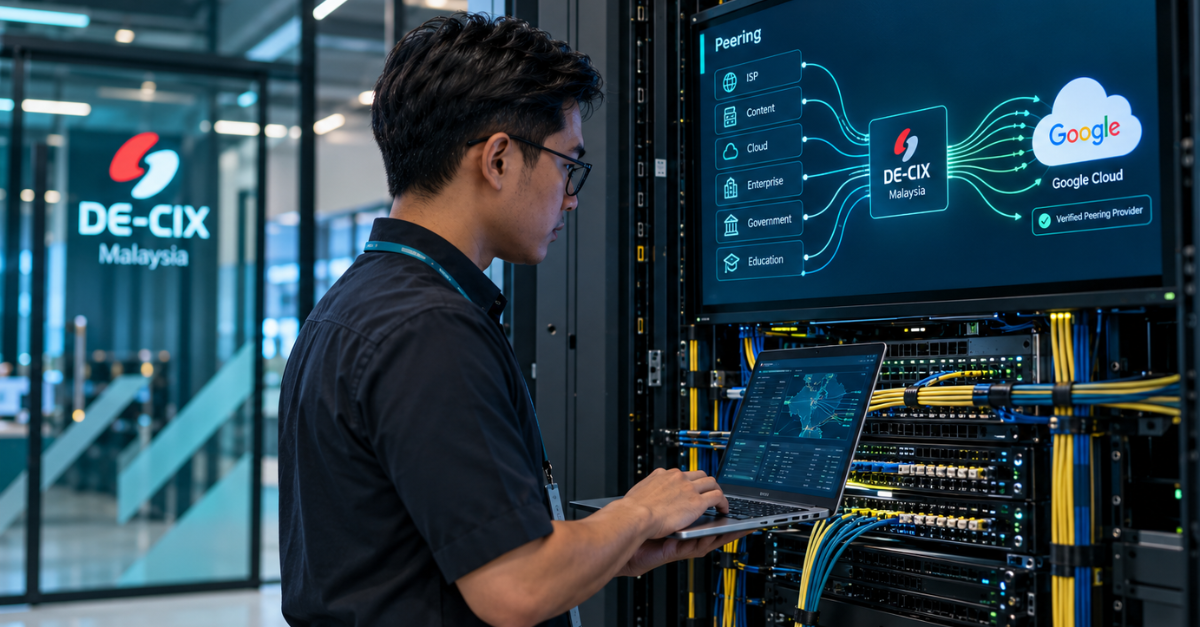
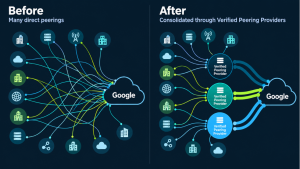
Most routing changes announce themselves with an outage. This one does not. Google has been stepping back from settlement-free direct peering arrangements at Internet Exchanges worldwide and directing networks toward its Verified Peering Provide (VPP) programme instead.
Nothing goes dark when this happens. Google prefixes simply stop arriving on the session you had, and start arriving via whoever else is advertising them — usually your transit provider, over a longer path, at a per-megabit cost. Traffic keeps flowing. The graphs shift a little. Latency drifts. Nobody files a ticket.
That is precisely why it is worth looking at deliberately rather than discovering it in a quarterly review.
Why Google Made The Change
The reasoning is not hard to follow from Google’s side. Direct peering at scale means maintaining a very large number of individual relationships, each with its own operational quality and its own failure behaviour. When one of those paths degrades, the user experience degrades with it, and Google owns the complaint regardless of whose network caused it.
The VPP programme replaces that long tail with a vetted set. Providers are assessed on the depth and physical diversity of their connectivity to Google, on the redundancy that keeps latency stable during an outage, and on having current operational contacts so faults get resolved quickly. Google revalidates enrolled providers periodically and publishes where each one connects, so customers can pick the provider nearest their workloads.
Badges are issued in two tiers, silver and gold, assigned purely on technical criteria relating to connectivity depth. The programme launched with around 40 ISPs across roughly 50 metropolitan areas and has since been opened to a wider pool.
What It Looks Like On Your Network If You Do Nothing
Four observable effects, roughly in the order teams notice them:
- Transit volume rises. Google property is a large share of most consumer-facing egress in Malaysia — Search, YouTube, Android updates, Workspace, Cloud and Gemini API traffic. Moving that from a peering session to a paid path is a direct cost transfer.
- Path length increases. Prefixes learned from transit typically arrive with more AS hops and often via a different country. In the Malaysian context that usually means Singapore.
- Latency becomes less consistent. Transit paths reroute on congestion and maintenance in ways a stable peering session does not. Averages may look acceptable while the 95th percentile tells a different story.
- Failure behaviour changes. A path you did not design is a path you cannot reason about during an incident, and Google Workspace outages get escalated to IT within minutes.
What Is Verified Peering Provide (VPP) Programme, Actually?
Stripped of programme language: a VPP is a provider that has already met Google’s direct peering requirements on your behalf, and through which you can reach all publicly available Google Cloud resources and public Google services without meeting those requirements yourself.
The requirements are not trivial. Physically diverse connectivity into Google’s network. Redundancy sufficient to keep latency changes small when something fails. Maintained operational contacts. Ongoing revalidation. Meeting all of that independently is reasonable for a large carrier and disproportionate for a regional ISP, a CDN node or an enterprise whose actual requirement is simply that Workspace behaves.
Using a VPP moves the peering operations off your plate without moving the quality down. You are not taking a best-effort path; you are taking a path Google has inspected.
Where This Leaves Malaysian Networks
DE-CIX is a Google VPP and has been adding Google prefixes to its peering platforms as the direct peering wind-down proceeds.
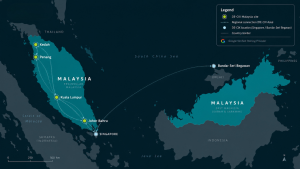
For a network in Malaysia, the practical consequence is straightforward. The existing DE-CIX access in Johor Bahru, Kuala Lumpur, Penang or Kedah already carries multilateral peering via the route servers, regional reach into DE-CIX Asia, and DirectCLOUD private connections into AWS, Azure and Google Cloud. The Google public-services path arrives over the same access, on infrastructure Google has validated, without a separate circuit, a separate contract or a separate set of requirements to satisfy.
This is the least interesting way to solve the problem, which is generally a compliment in network engineering.
A Practical Way To Work Through It
None of this needs a project. It needs an afternoon.
- Measure the exposure. Pull 30 days of egress by destination ASN and establish what share is Google property. Most Malaysian operators find it is larger than they assumed.
- Find where those prefixes are learned today. Peering session, route server, or transit — and check whether that answer changed in the last two quarters without anyone flagging it.
- Check Google’s published tooling. The ISP portal shows your current usage and peering posture from Google’s side, which is often more accurate than internal assumptions.
- Test the replacement path before you need it. Compare RTT and p95 over a VPP path against your current transit path, at peak rather than at midnight.
- Design for diversity, not just presence. One validated path is better than none; two, in different metros, is the configuration that survives a maintenance window.
- Write down the failure behaviour. If the Google path degrades at 9am on a Monday, the runbook should already say who is called and what is checked.
Why The Timing Matters More Than It Looks
Google traffic is not a fixed share of a growing pie. Gemini APIs, Workspace, Cloud services and the AI features now embedded across Android and Chrome are all pushing that share upward, in a market where Malaysia is simultaneously becoming a place where workloads are hosted rather than only consumed.
A path decision made in 2026 will be carrying considerably more traffic in 2028 than the spreadsheet currently assumes. Making it deliberately, while there is no incident forcing the issue, is the cheap version of this conversation.
The One-Line Summary
The session you used to have with Google is going away. The question is not whether your users still reach Google — they will. It is whether they reach it over a path you chose and can account for, or a path that simply happened to be left over.
Interconnect in Malaysia. Scale Across ASEAN. Connect Globally.
Working Hours: Monday – Friday, 9am – 6pm
Call Us: +603 9212 5961
Email Us: enquiry@de-cix.my