
Your Data Doesn’t Travel In A Linear

A Photo, A Friday Evening, And A Detour
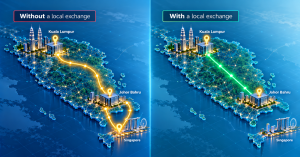
Say you are in Johor Bahru and you send a photo to your cousin in Kuala Lumpur. On a map, that is about 330 km up the North-South Expressway. Four hours if the traffic behaves.
Your photo, for many years and on many networks, would not have taken that route. It would have travelled south first, crossed into Singapore, found a place where your network and your cousin’s network could hand traffic to each other, and then come back north into Malaysia.
Two Malaysians. Two Malaysian networks. One international round trip to say hello.
Why The Detour Happens At All
The internet is not one thing. There are thousands of separate networks that have agreed to carry each other’s traffic. Your mobile operator is one. Your office broadband provider is another. A streaming service, a bank, a government portal, a cloud platform — all separate networks, each with their own cables and their own rules.
For traffic to get from one to another, the two networks need somewhere to physically meet. If no such meeting point exists nearby, the traffic goes looking for one, and it will take whatever path is available rather than the shortest.
That is how a message between two people in the same country ends up with a passport stamp.
The Meeting Room
The fix for this is unglamorous and about thirty years old. It is called an Internet Exchange (IX)
Think of a shared meeting room in a neutral building. Any network can rent a seat. Once inside, they can hand traffic directly to anyone else in the room, without going through a middleman and without leaving the building. No one owns the room, which is precisely why everyone is willing to use it.
DE-CIX runs rooms like this in more than thirty cities worldwide, and in Malaysia operates in Johor, Greater, Penang, and Kedah. When your network and your cousin’s network are both in the room, that photo goes straight up the peninsula.
What Actually Changes For You
Shorter journey, less delay. Less delay shows up in places you would not necessarily connect to network routing:
- The online class where the teacher’s voice and mouth finally match.
- The e-hailing app that updates your driver’s position smoothly instead of teleporting them down the street.
- The payment that goes through before the queue behind you starts sighing.
- The livestream where you see the goal at roughly the same moment as the neighbours.
None of this is dramatic. That is the nature of good infrastructure — you notice it only in its absence.
And What Changes On A Bad Day
There is a second benefit, which matters more than the first even though it comes up less often.
Undersea cables get cut. It happens more than most people realise, usually by anchors, occasionally by earthquakes. When a country’s internet traffic depends on leaving the country to get anywhere, a cable fault turns into a domestic problem very quickly.
When Malaysian networks exchange Malaysian traffic inside Malaysia, a bad day abroad stays a bad day abroad. Local banking keeps working. Local government services keep working. The parts of the internet that live here keep behaving as though nothing happened, because for them nothing has.

Malaysia Has Started Treating This As A National Question
This is no longer only an engineering preference. Budget 2026 committed RM2 billion under MCMC to establish a Sovereign AI Cloud, so that national data is processed and stored within the country, as part of a broader RM5.9 billion commitment to AI research and commercialisation. Microsoft’s Malaysia West cloud region went live in Greater Kuala Lumpur in May 2025, with a Johor Bahru region since detailed.
Building all of that inside Malaysia and then routing the traffic out of Malaysia would be an odd way to finish the job. Keeping data local is a storage decision. Keeping traffic local is a routing decision. Sovereignty needs both.
A Quiet Mark Of Quality
One last thing worth knowing, because it is a useful signal in a field with very few of them.
Large platforms increasingly publish which providers they trust to carry traffic to their services properly. Google runs a programme along these lines, checking that a provider connects to it with enough redundancy and diversity to hold up when something breaks, and then naming the ones that qualify.
DE-CIX is on that list.
It is not a marketing badge so much as a routing fact. When Malaysian networks reach Google services through DE-CIX, they are using a path Google has examined and approved.
The Takeaway
Most of what makes the internet feel fast has nothing to do with the device in your hand. It is decided long before that, by whether the networks carrying your traffic have somewhere sensible to meet.
For a long stretch, Malaysia’s sensible meeting place was in another country. That is changing, quietly, one exchange at a time. Your photo is taking a shorter road than it used to.
Interconnect in Malaysia. Scale Across ASEAN. Connect Globally.
Working Hours: Monday – Friday, 9am – 6pm
Call Us: +603 9212 5961
Email Us: enquiry@de-cix.my