
Data Sovereignty In Malaysia: Turning Policy Into An Auditable Network Route

Malaysia has no strict data residency law. Instead, since April 2025, it has something harder: the Minister’s whitelist is gone, and data controllers must independently verify that foreign receiving jurisdictions meet Personal Data Protection Act (PDPA) standards. You must run a transfer impact assessment Malaysia review and maintain audit records for every cross-border flow.
Most compliance teams know where data rests, but almost none know where it travels. An unevidenced sovereignty claim is just an assertion—and assertions fail audits. To keep data in Malaysia, you need an auditable network route.
Three Forces Changing the Rules
- The Legal Shift: The PDPA Amendment Act 2024 and April 2025 Cross Border Guidelines place full accountability on data controllers. DPOs face personal liability at 10,000 (sensitive) or 20,000 (general) record thresholds.
- National Mandates: Budget 2026 committed RM2 billion for MCMC’s sovereign cloud Malaysia rollout under AI Nation 2030. Sovereignty is now a core procurement metric.
- External Reach: US BIS rules target remote GPU compute access through South-East Asian data centres, while FCC import bars target optical transceivers. Jurisdiction is being enforced over transit paths, not just server racks.
The Compliance Blindspot
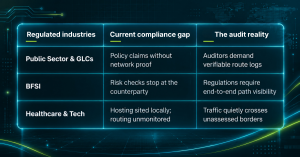
Standard architecture diagrams show hosting locations, not packet routing. When local apps query cloud endpoints or third-party APIs, dynamic BGP routing frequently hairpins traffic through foreign Internet Exchange Points (IXPs) before returning home.
You cannot complete a transfer impact assessment for a jurisdiction you did not know your traffic entered.
Compressing Your Audit Footprint
The cheapest transfer impact assessment is the one you never have to write. Routing traffic locally drastically reduces your compliance exposure:
Four Steps to Legally Defensible Routing
- Private Interconnection: Services like VirtualPNI create direct Layer 2 connections between known counterparties. Traffic never touches the public internet or foreign jurisdictions.
- Multi-Node Platform Reach: Connect to 135+ networks across four Malaysian locations (KL, Johor Bahru, Penang, Kedah) with 2.9 Tbit/s capacity to bypass transit intermediaries. Use GlobePEER ASEAN for single-contract regional routing.
- Contracted Cloud Paths: Replace public internet routes with contracted cloud paths like DirectCLOUD and Cloud ROUTER for deterministic, direct cloud access.
- Unified Infrastructure: Pair local network routes with Malaysian-owned facilities (Open DC’s JB1, JB2, CJ1, PE2, D8-1) to evidence physical and network sovereignty in a single file.
The Route File Documentation Standard
A defensible compliance file contains five essential records:
- On-Net ASN Map: Direct single-hop networks bypassing foreign transit.
- Jurisdictional Path Trace: Documented routes for primary and failover paths.
- Private Interconnection Agreements: Verification of Layer 2 isolation (VirtualPNI/DirectCLOUD).
- Physical Siting Proof: Confirmation of hosting in sovereign facilities.
- Timestamped Verification Logs: Date-stamped routing table snapshots refreshed quarterly.
Under Malaysia’s PDPA framework, local hosting alone cannot protect DPOs from liability when unmonitored BGP routing hairpins data across foreign borders. Achieving true data sovereignty requires replacing unpredictable public internet transit with deterministic, locally audited network paths that eliminate transfer impact assessment overhead.
Your organisation can keep traffic locked within sovereign boundaries and back every policy claim with immutable route logs; through DE-CIX.
Interconnect in Malaysia. Scale Across ASEAN. Connect Globally.
Working Hours: Monday – Friday, 9am – 6pm
Call Us: +603 9212 5961
Email Us: enquiry@de-cix.my