
Your Data Is In Malaysia. But Does Your Traffic Stay Here?

Most Malaysian organisations know where their data is stored. It may sit in a local data centre, a Malaysian cloud region or another approved facility. But there is another question that receives far less attention: where does that data travel while it is being used?
Data residency tells us where data rests. Routing tells us how it moves between users, applications, clouds and networks. An organisation may keep its data in Malaysia while still having limited visibility into the route its traffic takes to reach its destination.
That raises a simple question: if two networks are in Malaysia, should their traffic need to leave Malaysia to reach each other?
The Internet Does Not Always Take The Route You Expect
Internet traffic does not move according to geography alone. It follows routes determined by network providers, upstream carriers, peering relationships and routing policies. This means traffic between two Malaysian networks can sometimes take a longer path than expected. Depending on how the networks are connected, it may pass through additional infrastructure or another jurisdiction before reaching its destination.
Nothing has necessarily gone wrong. The Internet is simply using the route available to it.
The problem is that many organisations know where their systems are located, but have never looked closely at how traffic actually reaches them.
Interconnection Matters
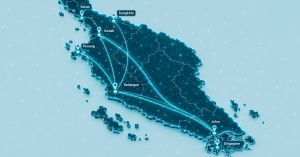
DE-CIX Malaysia exists to give networks another option.
Instead of relying only on upstream transit providers, networks connected to DE-CIX can exchange traffic more directly with other participating networks through a neutral interconnection platform. DE-CIX Malaysia currently connects more than 135 active ASNs across Greater Kuala Lumpur, Johor Bahru, Penang and Kedah. The value of that ecosystem increases as more networks connect because every additional local network creates another opportunity for traffic to be exchanged more directly.
This is the basic principle behind peering: when two networks need to communicate regularly, they can exchange that traffic directly rather than automatically sending it through a longer upstream route.
The result can be fewer network hops, lower latency and less unnecessary dependence on international transit. More importantly, it gives network operators greater control over how their traffic reaches important destinations.
One Destination, Two Possible Routes
A traceroute provides a simple way to see the difference.
Run the same test to the same Malaysian destination using two different network paths. One may depend on upstream transit, while another may exchange traffic through a local internet exchange (IX).
The destination stays the same, but the journey can be very different. The point is not to claim that every local route will always be faster or that every packet must remain within Malaysia. International connectivity remains essential.
The point is to understand whether traffic is taking the route the organisation actually wants it to take.
Beyond Public Peering

For some organisations, shorter routing is only part of the requirement.
Government agencies, financial institutions and regulated enterprises may also need greater certainty over who they connect to and how those connections are established.
This is where private interconnection becomes relevant.
DE-CIX services such as VirtualPNI and closed user groups allow specific parties to establish private connectivity without exchanging that traffic over the public Internet. Peering can shorten a route, while private interconnection can provide greater control over the path and the parties involved.
For organisations connecting to cloud environments, services such as DirectCLOUD and Cloud ROUTER can also provide more direct paths to cloud platforms, while GlobePEER ASEAN extends interconnection across the wider regional ecosystem.
This is why DE-CIX’s role is broader than simply providing an IX. It provides an interconnection layer where networks, enterprises and digital platforms can make more deliberate decisions about how traffic moves.
Do You Know Your Own Route?
The easiest place to start is simply to look.
Choose an important application or destination and run a traceroute. Examine the hops, latency and networks involved, then ask whether the route makes sense:
- Is Malaysian traffic remaining local where appropriate?
- Is an overseas path being used because no direct interconnection exists?
- Could an important destination be reached more efficiently through peering or private interconnection?
The answer may confirm that the network is working exactly as intended. Or it may reveal a route that has never been properly examined.
Either way, the organisation now knows more than it did before.
Knowing where data is stored remains important.
Knowing how it travels is what turns location into network visibility.
Interconnect in Malaysia. Scale Across ASEAN. Connect Globally.
Working Hours: Monday – Friday, 9am – 6pm
Call Us: +603 9212 5961
Email Us: enquiry@de-cix.my