
Everyone’s Talking Megawatts. Nobody’s Talking Milliseconds.

Across August, DE-CIX Malaysia screened 46 Malaysia-relevant industry records to establish what the market was genuinely discussing. Power dominated the coverage, followed by water. Land, approvals, investment totals and community objections accounted for most of the remainder. Connectivity was the least-covered topic in the entire set.
For an industry whose product is the movement of data, this is a significant omission. It is more significant still in light of the asymmetry between the constraints concerned. Power can be phased. Cooling can be retrofitted. Floor space can be taken in stages. A facility’s network position, by contrast, is fixed at the point of signature. The carriers present in the building, the exchange access available, the cloud
on-ramps in place and the physical fibre routes serving the site are inherited for the duration of the contract, and no subsequent investment materially alters them.
Megawatts are debated because they are straightforward to count. Milliseconds are omitted because very few operators publish them.
Reach Determines What Capacity Is Worth
A rack carries no intrinsic value. Its value derives entirely from the networks it can reach, the speed and reliability of that reach, and the cost per bit involved. Two facilities with identical power, cooling and certification can deliver materially different products according to what is on-net.
The effect is not marginal, and it presents in three distinct places across a buyer’s operational and financial reporting.
- Performance. Every additional autonomous system between a workload and its users introduces further delay, and introduces a further party capable of degrading the service.
- Cost. Traffic that cannot be peered locally becomes transit, and transit expenditure scales with growth. A well-connected site converts a variable cost into a substantially fixed one.
- Resilience. Approximately 97% of international data traffic moves across submarine cables. Malaysia has 23 operational subsea systems with further capacity planned, and the RM2 billion SALAM project will add 3,190 km linking Sedili in Johor to Kuching, Sibu and Sabah. This represents genuine national diversity. Diversity is only realised, however, where traffic is able to use more than one path, and a single-homed facility cannot.
None of this is visible in a megawatt figure.
The Arithmetic Of An Indirect Path
Latency has a floor determined by physics rather than by commercial positioning. Light in fibre travels at approximately two-thirds of its speed in a vacuum, which equates to roughly one millisecond of
round-trip delay for every 100 km of fibre. Switching, queuing and any middlebox on the path add to that figure. Nothing subtracts from it.
Applied to a Malaysian workload, the implications are readily calculated. Two networks in Kuala Lumpur exchanging traffic locally traverse a few tens of kilometres. The same two networks exchanging traffic by way of Singapore traverse approximately 400 km in each direction, or some 800 km on the round trip, before a single packet is switched. That represents close to eight milliseconds incurred through geography alone, on traffic that had no operational requirement to leave the country. From Penang the detour is considerably longer, and from the northern border corridor longer again.
Eight milliseconds appears immaterial until the behaviour of contemporary workloads is considered.
An AI application responding to a single user query may execute a retrieval step, a re-ranking step and a streamed generation, each with its own round trips. A payment authorisation traverses several services before returning a decision. A real-time bidding response is worthless if it misses its window. A trading system measures its advantage in precisely this unit. In each case the penalty is not incurred once; it is incurred on every hop of every transaction, throughout the operating day.
This has a direct bearing on how the market discusses artificial intelligence. The megawatt conversation has adopted AI as its principal justification, without acknowledging that inference is a latency workload as much as a power workload. Training is best sited where electricity is most economical. Inference must run close to its users, and its viability is determined by the round trip.
Domestic Traffic And The Singapore Detour
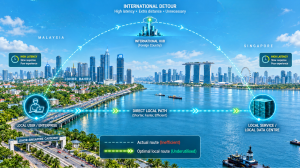
Johor’s proximity to Singapore is conventionally presented as an advantage, and for certain workloads it is. A distinction should nonetheless be drawn between reaching Singapore efficiently and depending upon Singapore in order to reach a domestic counterparty.
Peering in Johor Bahru retains Malaysian traffic within Malaysia. The distance saved is modest, given that the Causeway is a short hop. The border crossing is not modest. It alters the transit relationship, alters the cost base, introduces an additional jurisdiction into the data path, and renders a domestic flow dependent upon an international one. Johor Bahru occupies a genuine fibre interchange point between Singapore, Malaysia and the Indochina corridor, serving a catchment of approximately 230 million people. Traffic that crosses the Causeway only to return has paid for a border crossing it did not require.
Elsewhere in the country the case rests on straightforward distance. Penang’s semiconductor and industrial AI cluster lies several hundred kilometres from Singapore. The northern border corridor at Bukit Kayu Hitam is further still and addresses a different market entirely, situated under six kilometres from Thailand with more than 20 terrestrial cable routes and four cable landing stations carrying 16 subsea cables within a 120 km radius. For workloads serving northern Malaysia or southern Thailand, routing via Singapore constitutes a detour in every sense.
A Connectivity Disclosure Standard For RFPs
Connectivity is typically specified in adjectives: carrier-neutral, well-connected, and low-latency. Adjectives cannot be compared. Following a period in which announcements have consistently outrun delivery across this sector, buyers are entitled to discount any claim that is not quantified.
The following seven disclosures should be requested in writing, per site, and treated as a minimum standard.
- The on-net ASN list. Not a statement of carrier neutrality, but the specific networks reachable at the facility, identified by number.
- Exchange access at the building. Whether the internet exchange is present within the same facility, or requires a metro cross-connect and a separate contract.
- Cloud on-ramps. Which providers, by which method, and whether the connection is SLA-backed or best-effort across the public internet.
- Measured round trip to the ten principal destinations. Measurements rather than design figures, dated, taken from the site itself.
- Route diversity, described physically. Two paths sharing a duct constitute one path with additional invoicing.
- Peering capacity headroom. Current port utilisation and the documented upgrade path, so that present performance is sustained through growth.
- Interconnection availability at handover. Whether the network is live on occupation, or constitutes a second project on a second timeline.
A site unable to address these seven points is being marketed on power alone.
DE-CIX Malaysia’s Published Position

DE-CIX Malaysia’s position is stated in figures rather than description. The platform currently carries
135+ active ASNs, 2.9 Tbit of connected capacity and a peak of 402.40 Gbit/s, across four Malaysian locations: Kuala Lumpur, Johor Bahru, Penang and Kedah. Regionally, DE-CIX handled 1.2 exabytes across South-East Asia during 2025, representing growth of 140% year on year, against 79 exabytes globally.
These figures are material because reach operates as a network effect. Each ASN added shortens the path for another participant.
The platform is on-net where the capacity is located.
JB1, Johor Bahru hosts the DE-CIX JB node and JBIX, with 15 carriers, dark fibre to the main Causeway and to JB2, and DWDM and Metro Ethernet into Singapore, two kilometres from the crossing. Domestic traffic remains domestic, while international traffic takes the short path by design rather than by default.
PE2, Bayan Lepas operates a DE-CIX node with dark-fibre interconnection to PE1, within Penang’s semiconductor and industrial AI cluster, eliminating several hundred kilometres of detour for workloads serving the northern region.
D8-1, Bukit Kayu Hitam is DE-CIX Premium-enabled, with dark fibre to the Malaysia–Thailand border via Bukit Kayu Hitam-Sadao, within the dense cable environment described above.
Beyond peering, GlobePEER ASEAN extends regional reach from a single port, DirectCLOUD and Cloud ROUTER address hybrid and multi-cloud paths, and Microsoft Azure Peering is available on an
SLA-backed rather than best-effort basis.
The Constraint That Outlasts The Contract
Malaysia will continue to discuss megawatts, and appropriately so. The power constraint is real and the figures merit scrutiny. Power, however, is a solvable, phaseable, and negotiable problem. Network position is none of these. It is determined once, at signature, and it establishes the performance ceiling for everything that follows.
The industry measures what it debates. Connectivity has earned its place on that list.
Request a latency and reach profile before contracting: measured round trip from the site to your ten principal destinations, the on-net ASN list, and the cloud on-ramp inventory. Contact DE-CIX Malaysia, or request the on-net network list for JB1, PE2 or D8-1.
Interconnect in Malaysia. Scale Across ASEAN. Connect Globally.
Working Hours: Monday – Friday, 9am – 6pm
Call Us: +603 9212 5961
Email Us: enquiry@de-cix.my