
Beyond The Powered Shell: Why Malaysia’s Next Data Centre Wave Demands Interconnection

Malaysia is on the brink of a massive digital transformation, with an estimated 2 GW of data centre capacity slated to come online. S&P Global Ratings projects this buildout will absorb over
US$20 billion in private credit, project finance, and structured capital.
Yet, the digital infrastructure market is quietly heading toward a systemic misallocation of capital.
The industry remains obsessed with megawatts (MW). Pitch decks promise raw scale—powered shells, massive land footprints, and tier-rated cooling systems. But in an era where capital efficiency dictates survival, capacity is merely an expense until it is activated.
Without deep, pre-engineered interconnection, these MW monsters risk becoming glorified, highly expensive power grids.
The Megawatt Delusion: Capacity Does Not Equal Cash Flow
The core mistake in modern data centre underwriting is treating a megawatt as a metric of demand. It is not. A Mw measures potential supply; interconnection dictates realised utilisation.
- Facility A (The Isolated Shell): Offers top-tier power and cooling, but forces every incoming enterprise tenant to negotiate its own fibre routes, order backhaul, and figure out long-haul transport.
- Facility B (The Interconnected Hub): Houses a thriving Internet Exchange (IX) environment. Multi-cloud on-ramps, direct peering, and private virtual interconnects are pre-provisioned at the rack level.
Facility A delivers space and power. Facility B delivers speed to revenue.
For a CFO, Facility A incurs a heavy “transport tax” and delayed activation. For an investor, it means extended ramp-up timelines, elevated concentration risk, and lower long-term asset yields.
The Capital Allocator’s Dilemma: Underwriting Ecosystems, Not Concrete
As domestic Malaysian banks reach exposure limits, international private credit and structured finance funds are stepping in. But evaluating a data centre through a real-estate lens—focusing solely on land acquisition, steel, and power purchase agreements—is a dangerous oversight.
When private credit funds underwrite digital infrastructure, interconnection must sit at the centre of the asset stress-test:
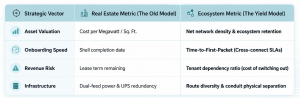
Interconnection platforms like DE-CIX Malaysia—with regional peering capabilities like GlobePEER ASEAN and direct cloud connectivity—aren’t just optional IT add-ons. They are the essential operational layer that converts static megawatt allocations into liquid, enterprise-grade digital assets.
Five Hard Questions For The Credit Committee
Before deploying the next dollar of alternative capital into Malaysian data centres, investment committees must push past carrier marketing brochures and demand operational proof:
- Is the “Carrier-Neutral” claim real or illusory? Are there active, multi-party peering networks in the Meet-Me-Room today, or just passive fibre dark-tubes waiting for a contract?
- Where is the physical failure point? Do the facility’s “diverse” fibre paths run through separate street vaults, or do they merge into the same physical trench 50 meters outside the gate?
- What is the true cost of customer activation? How many weeks—and how many thousands of dollars in transport fees—does it take a new tenant to reach AWS, Azure, or Google Cloud from this rack?
- Is the facility AI-ready at the network layer? High-density AI inference demands low-latency east-west traffic flow across regional hubs. Can the network architecture support dynamic scaling without physical retrofits?
- Does the capital plan account for network growth? Is meet-me-room footprint, cross-connect patching capacity, and exchange port density scaled in lockstep with phase 2 and phase 3 power rollouts?
The Shift From Supply To Serviceability

Malaysia’s geographical advantage and supportive energy policy give it a window to dominate Southeast Asia’s digital economy. But supply alone does not guarantee dominance.
A power grid creates MW. An ecosystem creates a market.
The next cycle of digital infrastructure winning bids won’t belong to those who build the biggest shells. It will belong to the capital allocators and developers who realise that in the modern digital economy, an asset’s true value isn’t measured by how much power it draws, but by how frictionlessly its data moves.