
Private Cloud Connectivity in Malaysia

For banks, financial institutions, and large enterprises, choosing how to connect to the cloud requires more than a simple “public vs. private” checkbox. It is a strategic decision about giving each workload the exact level of control, resilience, and security the business impact demands.
The Cloud Decision Is Only Half The Architecture
Cloud strategy is frequently discussed as a choice of platforms, regions, and services. However, the harder, often overlooked question is how data actually travels between users, data centres, cloud environments, and business partners.
Applications can be distributed across multiple cloud providers, but if they all depend on a single internet circuit, one edge device, or one carrier route, the architecture is not truly resilient. A cloud estate might look incredibly diverse, while the underlying network remains dangerously concentrated.
This matters most when the workload handles payments, core operations, customer identities, or disaster recovery. For systems that simply cannot tolerate an unclear failure path, connectivity is not just a line item added after signing a cloud contract. It is a fundamental risk decision.
What Bank Negara Malaysia’s RMiT Framework Actually Requires?
Bank Negara Malaysia’s revised Risk Management in Technology (RMiT) policy sets a clear expectation for financial institutions: enterprise networks must be reliable, scalable, and secure. Crucially, the network services supporting critical systems must have no single point of failure.
The framework points to component redundancy, service diversity, and alternate network paths as expected controls. When it comes to cloud environments, the RMiT’s message is straightforward: resilience measures must match the criticality of the system.
This does not mean RMiT mandates a private connection for every cloud workload. Rather, financial institutions must select controls proportionate to the risk and be able to clearly explain the architecture, dependencies, and residual exposure. Even for organisations outside of the policy’s direct scope, this approach remains a sound operational risk practice.
The Public Internet Is Not Wrong; It’s Just Not Suitable For Every Workload
The public Internet remains appropriate for many public-facing or lower-risk services, provided it is backed by strong encryption, identity controls, and DDoS protection.

The primary limitation is control. Internet traffic moves through an externally routed environment where an organisation has minimal influence over the path, outside congestion, or the number of hops between the infrastructure and a cloud service. An encrypted VPN protects data in transit, but it does not eliminate the reliance on public routing.
A direct or private interconnection shifts this dynamic. It reduces reliance on public routing, provides dedicated capacity, and makes governance vastly easier.
An important caveat: A private connection does not automatically secure the application or make the architecture resilient. A single private circuit can still be a single point of failure.
Four Situations Where Private Interconnection Is Justified
Upgrading from public to private connectivity is often necessary in the following scenarios:
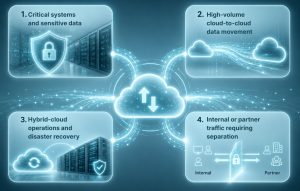
- Critical systems and sensitive data: If a workload handles payment processing, core banking integrations, or high-impact enterprise data, tighter control over how that traffic reaches the cloud is necessary.
- High-volume cloud-to-cloud data movement: Multi-cloud architectures often shuffle massive amounts of data between storage, AI, and security platforms. Sending this over the public Internet or backhauling it through an enterprise data centre adds operational complexity and exposure to
cloud-egress charges. A private routing layer provides a more direct exchange. - Hybrid-cloud operations and disaster recovery: True active-active application designs and reliable backups require more than a nominal second cloud. They require stable bandwidth and independent routes. Where recovery time and point objectives rely on stable data movement, private connectivity is usually the appropriate choice.
- Internal or partner traffic requiring separation: Some enterprise traffic is never intended for general Internet access. Point-to-point private connections allow for the controlled exchange of data with partners, sites, and service providers while keeping that traffic separate from public peering.
The Three Traps Of Multi-cloud Connectivity
As cloud environments scale, organisations must navigate three common network pitfalls:
- False diversity: Two cloud providers do not offer meaningful resilience if both rely on the same access circuit, edge router, or building entry point. Diversity must be traced end-to-end, not just inferred by counting cloud logos.
- Connection sprawl: Adding a new VPN or circuit for every single cloud fragments the network. RMiT specifically warns that point-to-point cloud connections can proliferate and contribute to fragmented identity and access management. Private connectivity should simplify governance, not create a tangled web of unmanaged links.
- Private-path complacency: A private link reduces public routing exposure, but it does not remove the need for encryption, continuous monitoring, and zero-trust principles. Network location alone must not create implicit trust.
Matching The Interconnection Service To The Problem
DE-CIX Malaysia provides several connectivity patterns. The optimal choice depends entirely on where traffic originates and its intended destination:
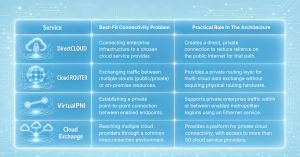
These services are building blocks. A target architecture may also require diverse access circuits, independent carriers, redundant equipment, and tested failover procedures.
A Cloud-Connectivity Assessment Should Produce Decisions
Before altering the network architecture, mapping workloads and their true dependencies is essential. A useful assessment moves beyond simple hardware inventories to deliver clear, actionable architectural choices.
A rigorous evaluation must directly audit the environment to:
- Classify workloads: Identify critical and time-sensitive applications, mapping exactly where their users, data, and recovery environments reside.
- Expose vulnerabilities: Pinpoint single points of failure across circuits and carriers, while highlighting traffic that relies too heavily on the public Internet or inefficient backhauling.
- Assign the right paths: Determine which data flows require direct, private connectivity, and which can safely remain public.
- Establish operational readiness: Clarify capacity needs, route diversity, and exactly who owns the service during a failover or incident.
The result is a defensible workload-to-path matrix. Low-risk services can remain on a simple, economical Internet model, while high-impact workloads are assigned the direct, private paths dictated by their risk profiles.
Multi-cloud resilience is not achieved simply by purchasing more cloud services. It is the result of understanding the entire service chain and removing hidden dependencies across applications, networks, and operating teams. Discussing a cloud-connectivity assessment with DE-CIX Malaysia can help map current traffic paths and ensure interconnection models align directly with actual business risk.
Interconnect in Malaysia. Scale Across ASEAN. Connect Globally.
Working Hours: Monday – Friday, 9am – 6pm
Call Us: +603 9212 5961
Email Us: enquiry@de-cix.my