
Closer To Users: Why Peering Matters For Cloud, CDN, OTT And Gaming In Malaysia

A stream starts slowly. A game session feels inconsistent. A cloud application performs well during testing, then struggles at peak time. The instinct is often to blame compute, code or the last mile. Yet the route between a platform and its users can be just as decisive.
Digital services are judged at the moment of use. Users notice response time, stability and consistency, not the location printed on a data-centre specification sheet. For cloud, CDN, content, OTT and gaming platforms, digital proximity must therefore be measured in network paths, not kilometres alone.
Hosting Closer Is Not The Same As Handing Traffic Over Closer
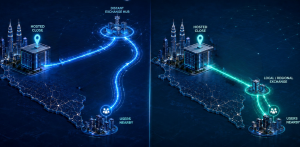
Placing infrastructure in Malaysia can shorten part of the journey, but it does not determine the entire route. A platform may be hosted near Malaysian users while its traffic is still handed to an upstream provider that exchanges it with the destination network somewhere else.
That route is not automatically wrong. It may reflect commercial agreements, available capacity, routing policy or resilience design. However, it may also add distance, network transitions and points of congestion that the platform team cannot directly control.
The underlying physics still matter. APNIC’s technical material on internet exchange (IX) and peering explains that latency rises with distance and queueing, while jitter reflects variation in delay. Packet loss, latency and jitter can all deteriorate as paths become longer or more congested. For real-time and
high-volume services, the pattern of performance matters as much as the average.
Peering gives networks another option. Instead of sending all suitable traffic through upstream transit,
two networks can exchange eligible traffic at a neutral IX. This can create a more direct and controllable handover where both parties are present and willing to peer.
Peering is still part of the Internet. It does not remove every intermediary, guarantee the shortest route or replace transit. It gives network teams a deliberate path for appropriate traffic and greater control over where that traffic changes hands.
One Network Issue, Different Business Consequences
The same route problem appears differently across each digital platform.
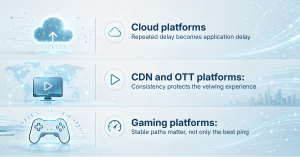
Cloud Platforms: Repeated Delay Becomes Application Delay
Cloud applications rarely depend on one request. A user action may trigger authentication, application logic, database calls, APIs and third-party services. Small delays can accumulate across these exchanges, especially when workloads span multiple environments.
For cloud providers and platform teams, peering can help place selected network handovers nearer to user and partner networks. The operational goal is not simply a lower headline latency figure. It is more consistent application behaviour across locations and peak periods.
CDN And OTT Platforms: Consistency Protects The Viewing Experience
Content platforms move large volumes of traffic, often in sharp peaks around live events, new releases or breaking news. Average throughput may appear healthy while congestion, packet loss or unstable routing produces slower starts, rebuffering or sudden quality changes for specific networks.
A CDN or OTT operator should therefore ask where content meets each major access network, not only where the cache or origin is located. Peering can create a clearer exchange point for suitable traffic and reduce dependence on an unnecessarily indirect transit path.
Gaming Platforms: Stable Paths Matter, Not Only The Best Ping
Gaming exposes network inconsistency quickly. Latency affects responsiveness, while jitter and packet loss can make an otherwise acceptable connection feel unpredictable. A strong off-peak test means little if the path changes or congests during evening demand.
For gaming infrastructure teams, the useful question is not, “What is our fastest result?” It is, “How stable are our routes across the networks and hours that matter most?” Peering decisions should be assessed against latency percentiles, jitter, loss, route changes and session stability, not one favourable speed test.
Ecosystem Reach Is A Network-design Asset
An IX is valuable when it brings a platform closer to the networks carrying its users, customers and partners. Raw participant numbers are less important than relevance. A content platform may prioritise major consumer access networks. A cloud platform may also value carriers, enterprises, other clouds and digital service providers.
DE-CIX documentation describes two complementary ways to establish peering. Route servers can simplify connections to many participating networks, while direct bilateral sessions can be established with selected peers. Network teams can use both approaches according to traffic volume, routing policy and operational priorities.
This is where ecosystem reach becomes commercially meaningful. One well-planned access can support multiple peering relationships without requiring a separate physical circuit for every network. As traffic with a particular peer becomes larger or more critical, the architecture can evolve with more specific policy or private interconnection where appropriate.
Transit remains essential for universal Internet reach and fallback. Peering is the optimisation layer for traffic where both networks see a reason to exchange directly. A resilient design normally uses each for the job it performs best.
Build From Malaysia Into ASEAN
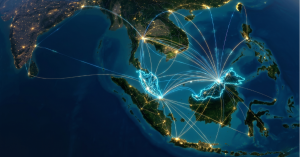
DE-CIX Malaysia currently operates carrier-neutral IXs in Kuala Lumpur, Johor Bahru and Penang.
This distributed Malaysian footprint allows platform teams to assess the exchange location that best matches their users, peer networks, backhaul and resilience plan.
The regional layer matters too. GlobePEER ASEAN combines local peering with access to participating DE-CIX IXs across Southeast Asia. According to the official service description, a network with access in one location can peer with networks at other DE-CIX exchanges in the region through the service.
For cloud, CDN, content, OTT and gaming providers, this supports a staged model:
- Connect at the Malaysian location that best matches the current traffic profile.
- Establish peering with relevant networks rather than treating every participant equally.
- Measure the traffic and user-experience change before moving more routes.
- Extend regional peering as demand grows across Southeast Asia.
- Keep transit and diverse access paths for reach, resilience and operational choice.
The result is not “local at any cost”. It is the ability to exchange suitable traffic closer to the people and networks using the service, while retaining deliberate regional and global paths.
Turn The Peering Decision Into A Measured Engineering Process
A strong peering plan begins with evidence. Before discussing a port, network and platform teams should build a traffic view that answers six questions:
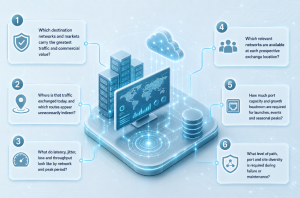
The port should be sized around peak demand, growth and resilience, not only current averages.
DE-CIX’s operational guidance also recommends monitoring backhaul capacity and traffic behaviour when peering routes are introduced, then expanding announcements in a controlled way.
Measurement must continue after go-live. The network team should track route changes, peer and transit traffic, port utilisation, latency percentiles, jitter and loss. Platform operations should compare those signals with user-facing outcomes.
For cloud services, that may include API response times, timeouts and error rates. For CDN and OTT platforms, it may include start time, rebuffering, delivered bitrate and origin offload. For gaming, it may include session latency, jitter, packet loss, disconnects and regional matchmaking quality.
This combined view prevents a common mistake: declaring success because one network metric improved while the customer experience did not.
The Strategic Question Is Where Traffic Meets The User
The next phase of Malaysia’s digital growth will not be defined by compute capacity alone. It will also depend on how efficiently platforms connect that capacity to users, access networks, clouds and digital ecosystems.
For network architects, infrastructure directors and platform operations teams, the decision is practical. Identify the users and networks that matter. Map the route. Measure the peak-period experience.
Then choose the peering location, policy and capacity that fit the traffic.
Your infrastructure may already be close to the market. The next step is to make sure the network path is close too.
Interconnect in Malaysia. Scale Across ASEAN. Connect Globally.
Working Hours: Monday – Friday, 9am – 6pm
Call Us: +603 9212 5961
Email Us: enquiry@de-cix.my