
Active-Active Connectivity: How Peering Improves Resilience and Business Continuity

In a digital economy powered by AI, cloud, digital banking, content delivery, and enterprise applications, business continuity can no longer depend on one site, one carrier, or one route.
For many organisations in Malaysia, resilience has traditionally been discussed at the data centre level: build a secondary site, add backup systems, replicate data, and test disaster recovery. These remain important, but they are no longer enough.
Today, the real question is not only whether an enterprise has more than one facility. The question is whether those facilities are connected through resilient, diverse, and active network paths.
Here, active-active data centre interconnect Malaysia strategies become critical. When workloads, users, and cloud services are distributed across multiple locations, connectivity must be designed to stay available even when one path is congested, degraded, or unavailable.
Why Single-Path Connectivity Creates Business Risk
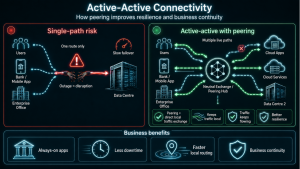
A single point of failure is not always a server. It can also be a route.
For infrastructure architects, disaster recovery planners, and enterprise IT leaders, route dependency creates several operational risks. A fibre cut, carrier outage, routing incident, or congested international path can affect application performance, service availability, and customer experience.
The impact is especially serious for sectors such as BFSI, telcos, cloud platforms, and digital service providers. These organisations operate mission-critical systems where downtime can affect transactions, customer trust, compliance processes, and service-level commitments.
In banking, for example, digital customers expect mobile apps, payment systems, and online platforms to always be available. In cloud and telco environments, customers expect stable access to applications, content, and services across regions. In enterprise IT, distributed users need predictable access to business-critical workloads.

Active-Active Connectivity Explained
Active-active connectivity means more than having a backup line.
In a traditional active-passive setup, one connection carries traffic while another waits as a standby. The standby link may only activate when the primary route fails. This model can work, but it may introduce failover delays, configuration complexity, and performance uncertainty during a real incident.
In an active-active connectivity model, multiple paths are live and available. Traffic can move across more than one route, site, or interconnection point. This supports stronger failover design because the network is not waiting for a cold standby to wake up during a disruption.
For enterprise IT teams, the benefit is simple: resilience becomes part of the live architecture, not only part of the recovery plan.
Why Peering Matters for Resilience
Peering improves resilience by giving networks more direct and controlled ways to exchange traffic.
Instead of relying heavily on long, indirect, or best-effort public internet routes, organisations can exchange traffic through a neutral Internet Exchange. This can help reduce unnecessary hops, improve routing efficiency, and create more options for traffic exchange.
For Malaysian enterprises, local peering is especially relevant. Keeping traffic local can reduce exposure to unnecessary international hairpinning, where Malaysian traffic leaves the country before returning to reach another Malaysian network or service. Local exchange, traffic localisation, and lower-latency routing are important themes for AI, cloud, and digital banking use cases.
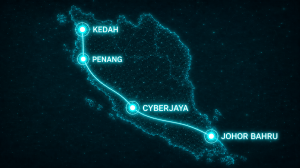
This is where DE-CIX JBIX plays a strategic role. DE-CIX Malaysia operates carrier-neutral Internet Exchanges in Kuala Lumpur, Johor Bahru, and Penang, offering premium peering, cloud connectivity, and interconnection services for ASEAN networks.
Resilience Is Built at the Interconnection Layer
Many organisations invest heavily in resilient servers, storage, and data centre facilities. However, if the network design is still dependent on limited routes, limited carriers, or a single traffic corridor, the overall architecture remains exposed.
A strong business continuity connectivity strategy should include:
Route Diversity
Traffic should have more than one viable path between users, workloads, data centres, cloud platforms, and network partners.
Carrier-Neutral Interconnection
Enterprises should avoid being locked into one carrier or one routing model. A neutral exchange ecosystem gives networks more flexibility to connect, peer, and scale.
Live Failover Readiness
Backup routes should not be treated as an afterthought. Active-active design keeps multiple paths usable and available.
Local and Regional Peering
Traffic should be exchanged as close as practical to users, applications, and digital ecosystems.
Cloud-Aware Connectivity

Modern disaster recovery often involves hybrid cloud and multi-cloud environments, not only secondary physical sites.
DE-CIX Malaysia’s services support this direction. Its official services page lists Cloud ROUTER, Cloud Exchange, VirtualPNI, Microsoft Azure Peering, DirectCLOUD, and GlobePEER ASEAN as part of its interconnection portfolio.
How DE-CIX Malaysia Supports Active-Active Design
DE-CIX Malaysia can support active-active connectivity strategies by giving networks a neutral platform to exchange traffic across multiple participants, locations, and service types.
For regional peering, GlobePEER ASEAN combines local peering with Southeast Asia-wide peering, allowing access from one location to peer with networks at other DE-CIX Internet Exchanges in the region. This helps improve latency, network stability, and end-user experience.
For cloud resilience, DirectCLOUD offers private, direct cloud connectivity that bypasses the public internet and supports low-latency access to cloud service providers. This is relevant for enterprises building hybrid cloud, disaster recovery, and multi-cloud architectures.
For private interconnection, VirtualPNI enables virtual private connections within and between metro regions, including between Kuala Lumpur, Johor Bahru, and Singapore. This can support enterprise network traffic, transit, paid peering, and private point-to-point connectivity models.
For multi-cloud environments, Cloud ROUTER allows direct and private data exchange between cloud environments, helping enterprises avoid backhauling traffic through inefficient routes or relying on
tunnel-based public internet solutions.
Together, these services help enterprises move from basic redundancy to a more resilient interconnection architecture.
How It Matters for BFSI, Telcos, Cloud, and Enterprise IT

For BFSI, active-active peering can support always-on digital banking, payment platforms, and
customer-facing applications.
For telcos and carriers, it can improve route control, reduce dependency on single transit models, and support better traffic exchange with partners.
For cloud platforms and managed service providers, it can strengthen hybrid cloud access, improve customer experience, and support regional workload distribution.
For enterprise IT leaders, it can reduce downtime exposure, improve disaster recovery confidence, and create a more scalable foundation for digital transformation.
The business case is clear: resilience is not only about recovering after a failure. It is about designing connectivity so that failure has less impact in the first place.
Build Resilience Before It Is Tested
Network incidents are not always predictable. Demand spikes, fibre cuts, routing changes, cloud disruptions, and congestion can happen without warning.
The organisations that respond best are usually those that have already engineered route diversity, peering flexibility, and active-active connectivity into their architecture.
As Malaysia’s digital infrastructure grows, enterprises should assess whether their network is truly resilient or simply duplicated on paper.
A secondary site without resilient interconnection is only half a continuity strategy. A backup link without active routing design may not deliver the performance required during a real incident. A cloud strategy without direct and predictable connectivity can still leave mission-critical workloads exposed.
To strengthen business continuity, enterprise IT leaders should review how traffic flows between data centres, clouds, users, and partners. They should identify single-route dependencies, unnecessary international hairpinning, public internet exposure, and failover weaknesses.
DE-CIX Malaysia provides a neutral interconnection ecosystem for organisations that want to build greater route diversity, improve peering resilience, and support active-active design across Malaysia and ASEAN.
Explore DE-CIX Malaysia’s Products and Services to assess how peering, cloud connectivity, and private interconnection can support your active-active connectivity strategy.
Build your active-active peering plan with DE-CIX Malaysia.
Interconnect in Malaysia. Scale Across ASEAN. Connect Globally.
Working Hours: Monday – Friday, 9am – 6pm
Call Us: +603 9212 5961
Email Us: enquiry@de-cix.my