
Expanding the Edge: The Next Frontier of Interconnection in Northern Malaysia

As AI, cloud, content and enterprise workloads become more distributed, the next advantage lies in how efficiently data can move across multiple locations, multiple networks and multiple borders. Malaysia’s data centre market is forecast to reach USD 16.02 billion by 2031, supported by AI demand, hyperscale activity, submarine cable growth and rising enterprise cloud adoption. But the real question is no longer only where capacity is being built. The more important question is where that capacity can interconnect.
Northern Malaysia begins to matter.
Redrawing Malaysia’s Interconnection Map
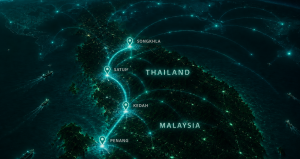
For years, regional interconnection discussions have been centred on the southern Malaysia-Singapore corridor. That remains critical, especially for carriers, content networks and cloud platforms serving dense user populations. However, a maturing digital economy cannot rely on one geography alone.
Kedah, Penang and the wider northern corridor are becoming more relevant because they offer a different kind of value: proximity to Thailand, access to industrial growth zones, route diversity, and a new edge position for traffic moving between Malaysia, Thailand and the wider Indochina region.
This is not about replacing established hubs. It is about extending the map.
A stronger Malaysian internet ecosystem needs both southern and northern anchors. Southern Malaysia supports high-density cross-border demand with Singapore. Northern Malaysia creates a strategic path towards Thailand and regional digital expansion. Together, they form a strong and resilient national interconnection fabric.
Why the Edge Now Matters More
The old model was simple: build capacity, connect it later. That model is no longer enough.
AI and cloud applications are changing the rules of infrastructure planning. Modern workloads depend on low-latency routing, local traffic exchange, secure cloud access and carrier-grade resilience from day one.
AI inference, cloud gaming, digital banking, streaming, enterprise SaaS and content delivery all perform better when traffic is exchanged closer to users and applications. When traffic travels unnecessarily through distant hubs, performance suffers, costs rise and resilience weakens.
This is why edge infrastructure is not only a data centre conversation; but an interconnection conversation. Without neutral peering, a facility is only a building. With neutral peering, it becomes part of a digital ecosystem.
Kedah’s Strategic Role in the Malaysia-Thailand Corridor
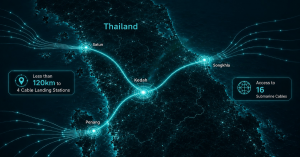
D8-1 in Delapan SBEZ positions Northern Malaysia as a practical interconnection point for cross-border digital traffic. The D8-1 DC is a DE-CIX premium-enabled site located less than 120km from four cable landing stations across Satun, Songkhla, Georgetown and Penang, with access to sixteen submarine cables.
Instead of depending on a single routing pattern, businesses can build for diversity. Instead of forcing traffic into legacy bottlenecks, they can localise exchange points closer to northern users, Thai routes and emerging Indochina demand.
Kedah is now a resilience play.
The DE-CIX Malaysia Advantage

DE-CIX Malaysia sits at the centre of this shift. Through DE-CIX JBIX, networks gain access to a neutral interconnection ecosystem designed for efficient traffic exchange, cloud connectivity and regional scale.
- For cloud and content players, the value is clear: reach more regional eyeballs through a scalable, neutral and secure interconnection layer.
- For telcos and ISPs, the value is equally direct: reduce unnecessary transit, improve traffic localisation and strengthen network performance.
- For enterprises, the benefit is operational: better cloud access, stronger resilience and less dependence on one connectivity route.
From Capacity to Connected Capacity

Malaysia’s digital growth will only be significant through connected capacity. A data centre without rich interconnection can become isolated infrastructure. A data centre with neutral peering becomes a platform for AI, cloud, content and enterprise growth.
This is why DE-CIX Malaysia is critical to the northern expansion story. It brings the missing layer that turns physical infrastructure into digital advantage: secure, neutral, resilient and scalable interconnection.
As Malaysia strengthens its position between Singapore, Thailand and wider ASEAN, the northern edge deserves a bigger role in the national infrastructure conversation.
The future of connectivity is distributed.
Northern Malaysia is no longer just an expansion zone; it is a strategic edge for Malaysia’s next phase of interconnection.
Interconnect in Malaysia. Scale Across ASEAN. Connect Globally.
Working Hours: Monday – Friday, 9am – 6pm
Call Us: +603 9212 5961
Email Us: enquiry@de-cix.my