
Global Internet Infrastructure Remains Resilient Amid West Asia Tensions
Kuala Lumpur, 21st April 2026
Rising tensions in West Asia have raised fresh concerns over the resilience of global internet infrastructure, particularly across strategic submarine cable corridors such as the Red Sea and the Strait of Hormuz. According to Wong Weng Yew, Board of Management Member at DE-CIX Malaysia, the global internet has remained largely stable because it is built on route diversity, network redundancy, and distributed interconnection.
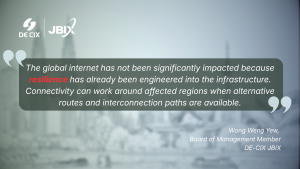
“The global internet has not been significantly impacted because resilience has already been engineered into the infrastructure. Connectivity can work around affected regions when alternative routes and interconnection paths are available,” said Wong.
Why the Internet Is Holding
The internet does not depend on a single route.
When a subsea cable, landing point, or network segment is affected, traffic can be redirected through alternative paths, supported by carrier networks, terrestrial fibre, submarine cable diversity, cloud connectivity, and Internet Exchange ecosystems.
This is where traffic engineering, peering, and route diversity become critical.
For global networks, resilience is not only about having more cables. It is about having multiple independent paths, strong peering ecosystems, and the ability to reroute traffic quickly when disruption happens.
Shift Toward Terrestrial Fibre Routes
The current crisis has also accelerated interest in terrestrial fibre routes across the Gulf.
Wong noted that countries such as Saudi Arabia, Oman, and the UAE have been investing in alternative land-based fibre corridors to reduce dependency on vulnerable maritime chokepoints.
These terrestrial routes act as “dry-land bridges,” helping traffic bypass high-risk subsea corridors and improving regional path diversity.
However, terrestrial fibre is not a perfect replacement for subsea systems. It still requires capacity planning, physical protection, cross-border coordination, and strong network operations.
The Real Risk: Latency, Congestion, and Capacity Pressure
While no major cascading global outage has been recorded, prolonged conflict can still create pressure on global connectivity.
The key risks include:
Higher latency
Traffic may need to travel through longer routes, affecting real-time applications, cloud services, financial platforms, and latency-sensitive workloads.
Traffic congestion
When more traffic is pushed into fewer safe corridors, available routes may face capacity pressure.
Physical infrastructure exposure
Both subsea and terrestrial fibre remain vulnerable to accidental damage, sabotage, regulatory delays, and repair constraints.
Digital Infrastructure Is Now Strategic Infrastructure
The situation highlights a major shift in modern conflict.
Digital infrastructure is no longer just a utility; but a strategic infrastructure.
Submarine cables, terrestrial fibre, Internet Exchanges, data centres, and cloud connectivity are now part of national and regional resilience planning.
“Modern conflicts are increasingly becoming digital conflicts. This makes national and regional resilience planning more important than ever,” said Wong.
What This Means for Malaysia and ASEAN
For Malaysia and ASEAN, the message is clear.
Digital resilience cannot depend only on international submarine cables. The region must continue strengthening domestic peering, carrier-neutral interconnection, terrestrial route diversity, and alternative international pathways.
A stronger local interconnection ecosystem allows more traffic to stay local, reduces circuitous routing through distant hubs, and improves performance during regional disruption.
In an uncertain geopolitical environment, digital sovereignty will depend on how well countries design their interconnection fabric.
The internet remains resilient.
But the next phase of resilience will be built through peering, path diversity, local traffic exchange, and strategically located digital infrastructure.
Interconnect in Malaysia. Scale Across ASEAN. Connect Globally.
Working Hours: Monday – Friday (9am – 6pm)
Call Us: +603 9212 5961
Email Us: enquiry@de-cix.my